

DefenseHub · Friday · Intelligence · October 9, 2026

A federal case in Los Angeles raises questions about alleged Chinese government surveillance of a Taiwanese political family on US soil. Wanying Zhang, 34, of Irvine, California, will stay in jail pending trial on an allegation that she watched the son of Taiwan's president outside his home near Seattle on behalf of Chinese officials. The FBI arrested her at Los Angeles International Airport on October 4, 2026, before a planned flight to China. NBC News reports that a judge sided with prosecutors on October 7, who argued she poses a flight risk. Zhang has not been convicted, and the charge does not allege she stole or passed along classified information.
What We Know
The Justice Department's October 5, 2026 press release summarizes the charge. It states that Zhang was arrested on a one-count criminal complaint accusing her of acting in the United States as an unregistered agent of the government of the People's Republic of China. The alleged conduct includes surveillance on family members of a high-ranking Taiwanese government official. According to the DOJ, Zhang met PRC officials in China in June 2025 and was tasked with conducting surveillance in the United States. These are allegations in a complaint, not findings of guilt.


The alleged offense concerns acting in the United States under a foreign government's direction or control without prior notification to the Attorney General as required by federal law. That requirement differs from registration under the Foreign Agents Registration Act. The offense does not require a transfer of classified information. Prosecutors allege that Zhang conducted surveillance and sent material to a PRC contact. NBC News identifies the target as a son of Taiwan's president, observed outside his residence in the Seattle area. Its account of the complaint describes photographs, video and license plate information allegedly sent to her contact.

The DOJ release describes travel and messages, including license plate numbers allegedly sent to a PRC official, as well as surveillance alongside another individual. Neither the DOJ nor NBC identifies that person by name. NBC reports that prosecutors said the person had left for China two weeks before the October 7 hearing. The judge's ruling kept Zhang in custody on flight-risk grounds. It does not establish that the surveillance allegations are true, or determine her role in an intelligence operation.
The alleged conduct is described in some detail; its truth and the operation's full scope remain unproven.
The reference to other individuals raises questions about recruitment, payment and the chain of command. Those questions require more than a press release and a news account of the complaint; neither should be treated as a complete record of the case. NBC also reports a defense challenge to the prosecution's characterization of Zhang as a sleeper agent. Her lawyer argued that her family connections in Southern California weighed against a risk of flight. Those arguments concern detention and characterization; they do not supply a complete defense account of the alleged surveillance.
Whether prosecutors can prove foreign-government direction and the alleged conduct beyond a reasonable doubt remains a question for the criminal proceedings.
Operational Context
The charge filed against Zhang concerns alleged foreign-government direction and activity on US soil. Observing a residence and recording vehicles does not require access to a classified system. That does not make the information harmless: photographs and movements could have value to whoever requested them, though the sources do not establish what use was made of this material. A charge under the foreign-agent statute and a charge involving national defense information have different elements. The sources provide no basis for ranking one as an easier case to prove. The detention ruling addresses flight risk separately from those questions.
A separate Latvian case, announced in early October after arrests in June, offers a comparison of alleged state-directed intelligence activity. Latvia's State Security Service, the VDD, reported on October 1, 2026 that it and the Defence Intelligence and Security Service had detained two Latvian citizens on June 28 on suspicion of spying for Russia's GRU military intelligence service. According to the VDD, investigators found that the suspects collected and transferred information about Latvia's defense system, NATO activity and support for Ukraine. The cited sources identify no connection to Zhang's case.
The VDD says one suspect used a small private aircraft to conduct reconnaissance and take aerial photographs of the Ādaži military base on behalf of the GRU. It separately describes activities for potential support of reconnaissance-sabotage groups in Latvia; it does not explicitly identify the photographs as serving that purpose. The Latvian allegations concern military facilities and allied activity. The Zhang complaint concerns surveillance of a political family member at a residence. The targets and alleged activities differ, and neither case establishes the other case's facts.
Nothing in the Latvian reporting or in the NBC News and Justice Department material on Zhang suggests any coordination or connection between the two cases. The comparison here illustrates only that state-linked intelligence tasking can take different forms depending on what is being pursued, not that the Zhang case is part of a larger pattern involving Russia or any other state.
My Read
The publicly described allegations include an additional participant and transmission of surveillance material to a PRC contact. They give a more specific account than a bare accusation of watching someone. If proven, a Chinese government tasking to monitor the son of Taiwan's sitting president in a US residential neighborhood would show an ability to arrange collection outside China. That conclusion depends on evidence establishing the relationship, instructions and conduct. Alleged transmission also needs to be distinguished from theft of classified information, which the single charge does not allege.
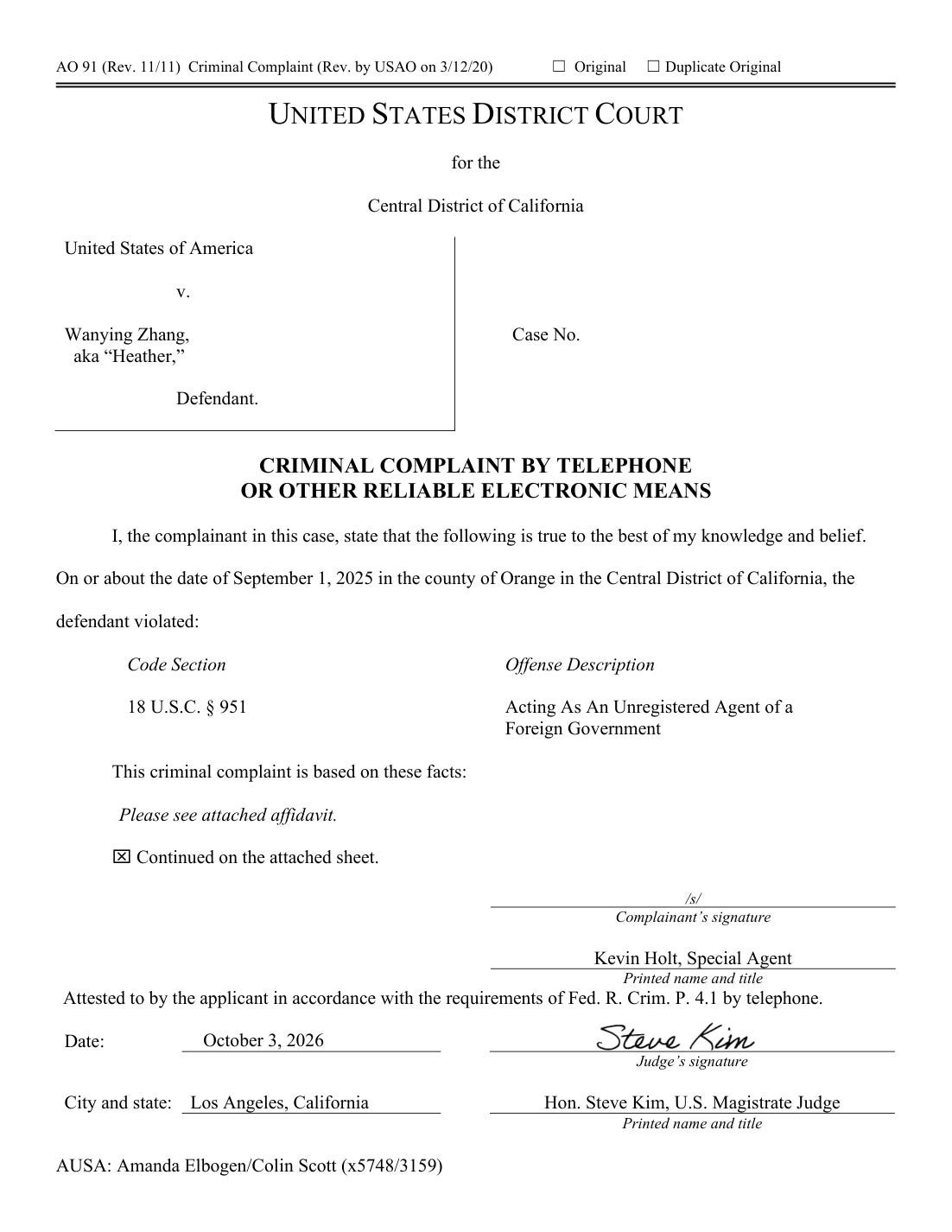
The available reporting does not establish how much responsibility Zhang had, how the assignment was organized, or whether it belonged to a wider operation. A limited role is possible, but there is no basis here to assign competing explanations equal probability. NBC's account includes her lawyer's rejection of the sleeper-agent characterization and arguments based on family ties. The judge nevertheless ordered detention. That decision concerns flight risk before trial; it does not measure Zhang's intelligence value or resolve the allegations against her.
The alleged collection and transmission could matter even without classified material: information about a family member's location or vehicles could support further monitoring. That is an assessment of possible utility, not proof of downstream use or harm in this case. The reported travel with another individual supplies a concrete lead about participation, but it does not establish a network of known size. A fuller complaint record, evidence tested in court, additional defendants or documented financing could clarify who directed the activity and how it was supported.
For now, the confirmed procedural facts are a criminal complaint and a detention ruling. The underlying surveillance and foreign-government direction remain allegations. The case deserves attention because of the alleged target and tasking, rather than because detention proves an intelligence operation succeeded. The scale of any broader network and the consequences of the alleged collection remain unresolved. Later filings may strengthen, narrow or challenge the present account; an acquittal would mean the prosecution failed to prove guilt beyond a reasonable doubt, not necessarily that every reported event was disproved.
What to Watch
The content of any new charges or court filings could clarify whether prosecutors allege additional collection or transmission of information.
Newly identified defendants or participants could clarify roles and the scope of the alleged activity; names alone would not establish a wider network.
Taiwan's presidential office or Ministry of Justice issuing a public statement on the Zhang case would show how Taipei is treating the allegation.
Evidence tested in court and the outcome of the proceedings will determine whether prosecutors prove the alleged offense beyond a reasonable doubt.
Recommended Sources
NBC News: primary reporting on the October 7 detention ruling and flight-risk finding.
Department of Justice press release: an official summary of the single-count criminal complaint and alleged conduct.
UA.News: reporting on the Latvia GRU espionage detentions, used here only as a labeled comparison.
Latvian State Security Service (VDD): the primary release on the June 28 arrests and alleged collection, transmission and aerial reconnaissance in Latvia.
Sources & Methodology
This briefing is based on open-source reporting, official releases, procurement documents, defense-industry disclosures, and specialist analysis available at publication time. Claims involving battlefield effects, classified programs, or active operations are treated cautiously unless corroborated by multiple independent sources.
DefenseHub prioritizes primary sources where available, including official releases, budget and procurement records, legislative documents, technical disclosures, institutional research, and reputable reporting.
Corrections or source clarifications can be sent through the DefenseHub contact page.
R. Planche · DefenseHub