

NORTH KOREA COMMISSIONS SECOND NUCLEAR-CAPABLE DESTROYER
North Korea commissioned the guided-missile destroyer Kang Kon into its East Sea Fleet on September 6, its second nuclear-capable destroyer after Choe Hyon. ISW-CDOT assesses this naval expansion is part of a broader effort to disperse North Korea's nuclear weapons across platforms and domains for survivability.
AT A GLANCE
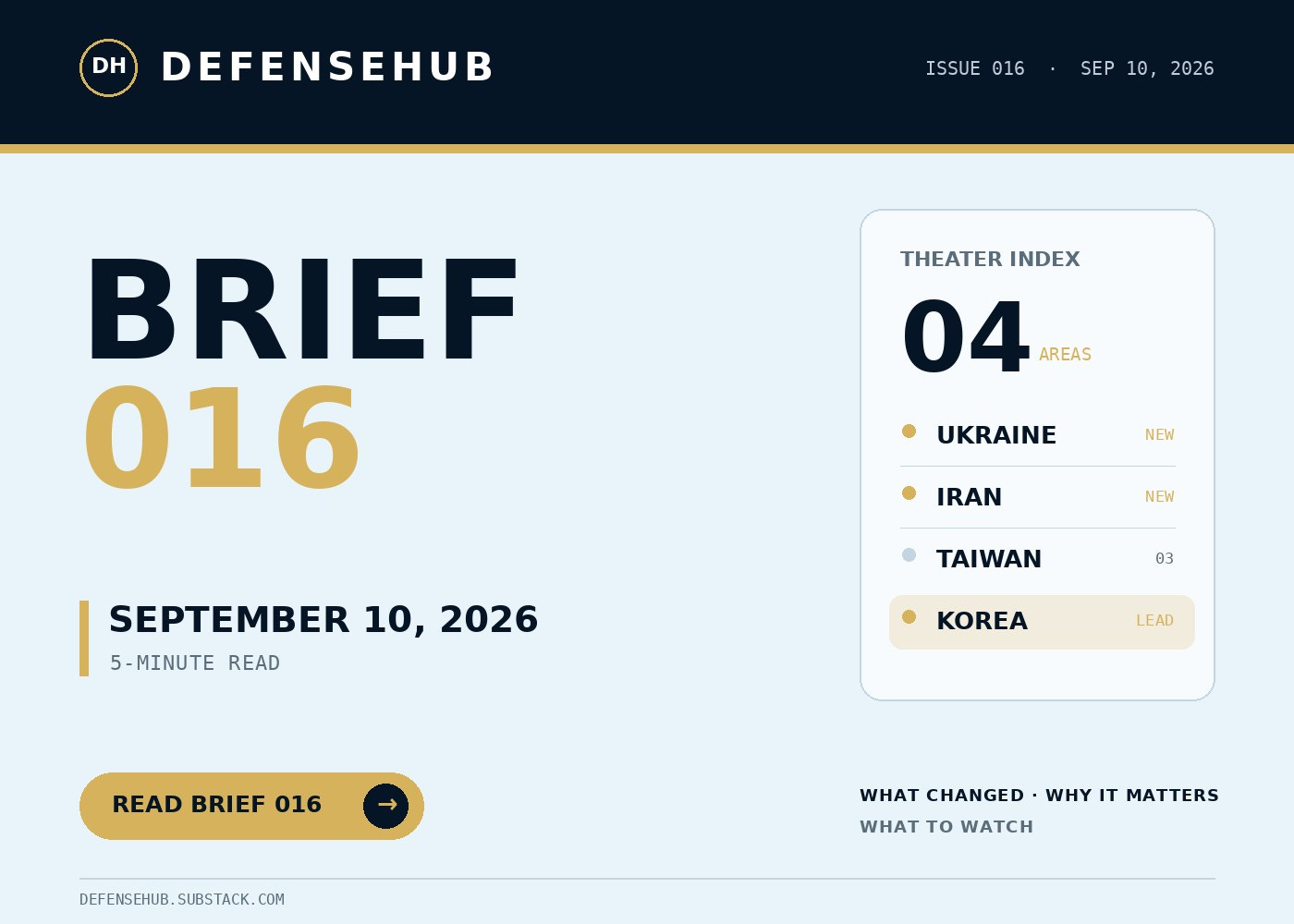
NEW | UKRAINE | Russian milbloggers acknowledge Ukrainian counterattacks near Lyman and criticize a culture of false battlefield reporting.
NEW | IRAN | Iran intensified attacks on US naval forces and stationary commercial vessels, reportedly using more sophisticated weapons.
CARRIED FORWARD, SEP 4 | TAIWAN | China's revised mobilization law, effective October 1, could expand requisitioning of civilian transport and drone assets.
NEW | KOREA | North Korea commissioned the destroyer Kang Kon and Kim Jong Un named the East Sea a strategic naval priority.
WHY THE KANG KON COMMISSIONING MATTERS
North Korea commissioned Kang Kon, its second nuclear-capable guided-missile destroyer, into the East Sea Fleet on September 6. Kim Jong Un called the vessel part of North Korea's nuclear counteraction system and said its crew must be ready for retaliatory strikes.
ISW-CDOT assesses that this naval expansion supports North Korea's effort to disperse nuclear weapons across platforms and domains, increasing survivability against a potential decapitation strike. Kim's remarks emphasized the East Sea over the West Sea as North Korea's primary maritime threat axis.
Kim stated that enemy warships have traversed the East Sea uncontested and said the KPAN's role is to force adversary fleets into strategic retreat. ISW notes North Korea may look to Iran's Strait of Hormuz campaign as a model for denying sea control to a stronger adversary.
Separately, North Korea's revised WPK Charter grants the Central Committee and Politburo wartime decision authority, which ISW-CDOT assesses is intended to signal a survivable nuclear command structure. These developments together indicate a deliberate push to harden deterrence signaling ahead of any future crisis.
OTHER SIGNALS
UKRAINE | MILBLOGGERS ADMIT LYMAN SETBACKS, FISCAL STRAIN GROWS
ISW report of September 9 · new
Russian milbloggers claimed on September 9 that the situation near Lyman is deteriorating for Russian forces, with unspecified withdrawals from forward positions. One milblogger said Ukrainian counterattacks have continued for months despite official 'optimistic' claims, and criticized the practice of false reporting, including around Svyatohirsk, which Ukraine controls despite Putin's earlier claim otherwise.
The Russian Ministry of Finance reported a budget deficit of 5.8 trillion rubles for January-August 2026, 1.5 times higher than the same period in 2025, driven by rising war-related expenditures outpacing revenue growth. ISW assesses this expansionary fiscal policy is crowding out non-war spending, likely at the expense of Russian citizens' wellbeing.
IRAN | STRIKES ON US NAVY AND STATIONARY TANKERS INTENSIFY
ISW report of September 9 · new
Iran has fired an unspecified number of ballistic missiles at a US carrier, destroyers, and a Marine vessel since September 4, according to US officials cited by the Wall Street Journal. US officials warned Iran may be using more sophisticated weapons, possibly with Russian or Chinese targeting assistance, and Iran used cluster munition ballistic missiles against US forces in Jordan on September 9.
Iran also struck stationary commercial vessels, including the Hercules Star off Dubai and an LNG tanker at Khor Fakkan, after US forces destroyed ten Iranian tankers since September 5. ISW-CTP assesses Iran likely targets anchored ships partly due to difficulty fixing moving targets and to pressure shipping companies over continued US strikes on Iranian tankers.
DEFENSEHUB ASSESSMENT
MEDIUM CONFIDENCE: North Korea's dual-coast destroyer deployment and East Sea rhetoric strengthen signaling of nuclear dispersal, while unresolved Lyman battlefield claims and Iran's tanker strikes indicate persistent contested-claims dynamics elsewhere.
CALL, 30 DAYS: DefenseHub expects North Korea to continue emphasizing East Sea Fleet operations and rhetoric over West Sea activity through early October. Falsified by North Korea prioritizing West Sea deployments or commissioning its next major combatant there instead.
TRACK RECORD
IRAN · OPEN: Iran escalated with cluster munition strikes on US forces in Jordan and repeated ballistic missile attacks on US warships, but full follow-through remains unresolved.
72-HOUR OUTLOOK
KOREA: Watch for further North Korean statements or naval activity reinforcing East Sea Fleet priority following Kang Kon's commissioning.
UKRAINE: Watch whether Russian milblogger criticism of false Lyman reporting prompts any official acknowledgment of losses there.
IRAN: Watch for continued Iranian strikes on stationary commercial vessels amid ongoing US tanker interdictions.
TAIWAN: Watch for implementation steps under China's mobilization law ahead of its October 1 effective date.
SOURCES & METHOD
Sources: Russian Offensive Campaign Assessment, September 9, 2026, Iran Update, September 9, 2026, China & Taiwan Update, September 4, 2026, Korean Peninsula Update, September 9, 2026. DefenseHub separates reported facts, disputed claims, and analytical judgments. Each theater carries the date of its last admitted ISW report, and a theater with no newer report for six days keeps its AT A GLANCE line without a section of its own. TRACK RECORD scores indicators published in earlier issues.
R. Planche · DefenseHub