

KREMLIN REJECTS ENERGY CEASEFIRE, RUSSIAN COPTER ENTERS POLAND
Kremlin Spokesperson Dmitry Peskov effectively rejected the US-Ukrainian proposed limited energy ceasefire on September 23, and a Russian Mi-8 helicopter separately violated Polish airspace near Braniewo for 42 seconds. ISW assesses the airspace violation is part of a Russian pattern testing Polish air defense readiness ahead of potential future aggression against NATO.
AT A GLANCE
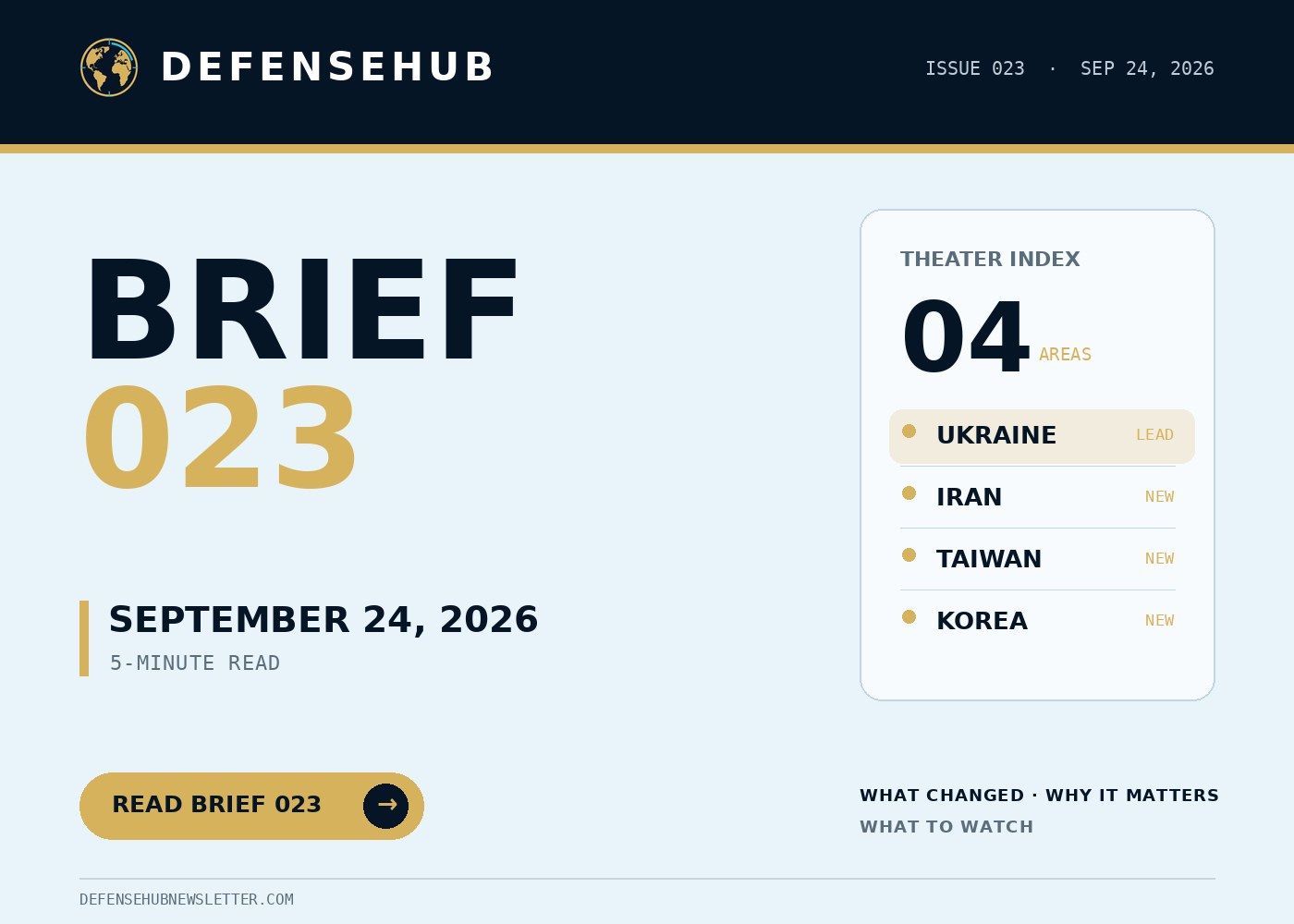
NEW | UKRAINE | Kremlin officials rejected a limited energy ceasefire while a Russian Mi-8 helicopter briefly violated Polish airspace near Kaliningrad.
NEW | IRAN | Iran held indirect UNGA talks with US officials amid economic strain but reportedly refuses to soften its core negotiating demands.
NEW | TAIWAN | Japan may pursue nuclear submarines while diverted F-35 components in Hong Kong raise reverse-engineering concerns, per ISW-CDOT.
NEW | KOREA | North Korea sharpened nuclear rhetoric and showcased possible hypersonic and unmanned systems following its September 20 missile tests.
WHY THE KREMLIN'S CEASEFIRE REJECTION AND POLAND INCURSION MATTER
The Kremlin's rejection of the limited energy ceasefire, delivered through Peskov's blunt characterization of Western proposals, shows Russia is not adjusting its position despite the absence of major battlefield gains. Peskov reiterated no preconditions exist for peace talks with Ukraine.
ISW reports that Russian MoD and milbloggers are simultaneously amplifying baseless encirclement claims around Kharkiv Oblast and Dobropillya, which ISW assesses as a cognitive warfare effort to obscure Ukrainian battlefield successes. Ukrainian and even some Russian sources dispute these encirclement claims directly.
Separately, ISW assesses that the Mi-8 helicopter's 42-second incursion into Polish airspace near Braniewo fits a broader pattern of Russian testing of NATO air defenses, following prior drone incursions and a 2025 mass drone incident. The Polish command called this a readiness test.
These two threads, diplomatic rejection and NATO airspace testing, are reported separately in the same ISW assessment and are not described as causally linked. DefenseHub synthesis notes they together indicate no near-term de-escalation signal from Moscow this week.
OTHER SIGNALS
IRAN | ECONOMIC PRESSURE DRIVES RENEWED US CONTACT
ISW report of September 23 · new
ISW-CTP reports that Iran's deteriorating economy and difficulty enforcing control over the Strait of Hormuz likely contributed to indirect US-Iran contact at the UNGA on September 22 through Qatari mediators. This was the first such engagement since June talks in Burgenstock collapsed.
ISW-CTP assesses Iran's willingness to engage does not indicate softened demands; Rezaei stated Iran will not negotiate or reopen the strait until the US meets its conditions first. Houthi forces are separately reported to be threatening an expanded naval blockade to deter Saudi partners from intervening.
TAIWAN | JAPAN WEIGHS NUCLEAR SUBS, F-35 PARTS DIVERTED
ISW report of September 22 · new
ISW-CDOT reports Japan's defense minister said Tokyo would not rule out acquiring nuclear-powered submarines, which could extend range and stealth against the expanding Chinese navy, though domestic legal and political obstacles remain unresolved.
Politico reported, per ISW-CDOT's citation, that a shipment of F-35 components was unexpectedly diverted to Hong Kong in transit from Australia, raising concern about possible Chinese reverse-engineering. The Pentagon's F-35 program office confirmed awareness of the shipment issue and is investigating.
KOREA | PYONGYANG SHARPENS NUCLEAR RHETORIC, TESTS HGV
ISW report of September 23 · new
ISW reports Kim Yo Jong denounced the Pacific Vanguard 2026 exercise on September 17 in unusually forceful terms and reaffirmed North Korea's nuclear deterrent commitments, referencing constitutional first-strike provisions tied to threats against state survival.
North Korean state media released images from September 20 tests suggesting a hypersonic glide vehicle, likely the Hwasong-11E-1, though South Korean and Japanese reporting on flight metrics differed, leaving the operational capability unconfirmed according to the source.
DEFENSEHUB ASSESSMENT
MEDIUM CONFIDENCE: Diplomatic rejection combined with a NATO airspace incursion suggests Moscow is not softening its stance; weakening indicator would be any follow-through on Rubio-Lavrov ceasefire framework signals.
CALL, 30 DAYS: DefenseHub expects no Russian acceptance of a broader ceasefire framework within 30 days. Falsified by a confirmed Russia-Ukraine agreement on any binding energy or grain ceasefire terms within that period.
TRACK RECORD
TAIWAN · RETIRED: Legislative Yuan budget review has been repeated across five issues without confirmed movement in the supplied snapshots; no further tracking warranted.
UKRAINE · OPEN: The Zelensky-Trump UNGA meeting outcome is not confirmed in this snapshot; Rubio-Lavrov talks referenced a limited ceasefire but no settlement.
72-HOUR OUTLOOK
UKRAINE: Watch for further Russian airspace incursions into NATO states and any Rubio-Lavrov follow-up statements on the ceasefire proposal.
IRAN: Watch whether US-Iran indirect contacts continue past UNGA or whether Iran's economic pressure prompts further sanctions responses.
TAIWAN: Watch for Pentagon findings on the F-35 component diversion and any Japanese government statement on nuclear submarine plans.
KOREA: Watch for further North Korean state media detail on the hypersonic test or additional Kim Yo Jong statements on US exercises.
SOURCES & METHOD
Sources: Russian Offensive Campaign Assessment, September 23, 2026, Iran Update, September 23, 2026, China & Taiwan Update, September 22, 2026, Korean Peninsula Update, September 23, 2026. DefenseHub separates reported facts, disputed claims, and analytical judgments. Each theater carries the date of its last admitted ISW report, and a theater with no newer report for six days keeps its AT A GLANCE line without a section of its own. TRACK RECORD scores indicators published in earlier issues.
R. Planche · DefenseHub