

DefenseHub · Monday · Geopolitics · 2026-06-08
The People's Liberation Army Navy pushed its Liaoning carrier strike group through roughly 170 takeoffs and landings east of Luzon between May 26 and May 28, its most intensive public flight operations in the Philippine Sea to date. The Japanese figures count takeoffs and landings; a sortie, strictly speaking, is one aircraft completing a full launch-and-recovery cycle. The count grabs attention, but the sustainment architecture behind it, and the unexplained drop in daily flight rates, tells you more about where China's naval power actually stands.
What We Know
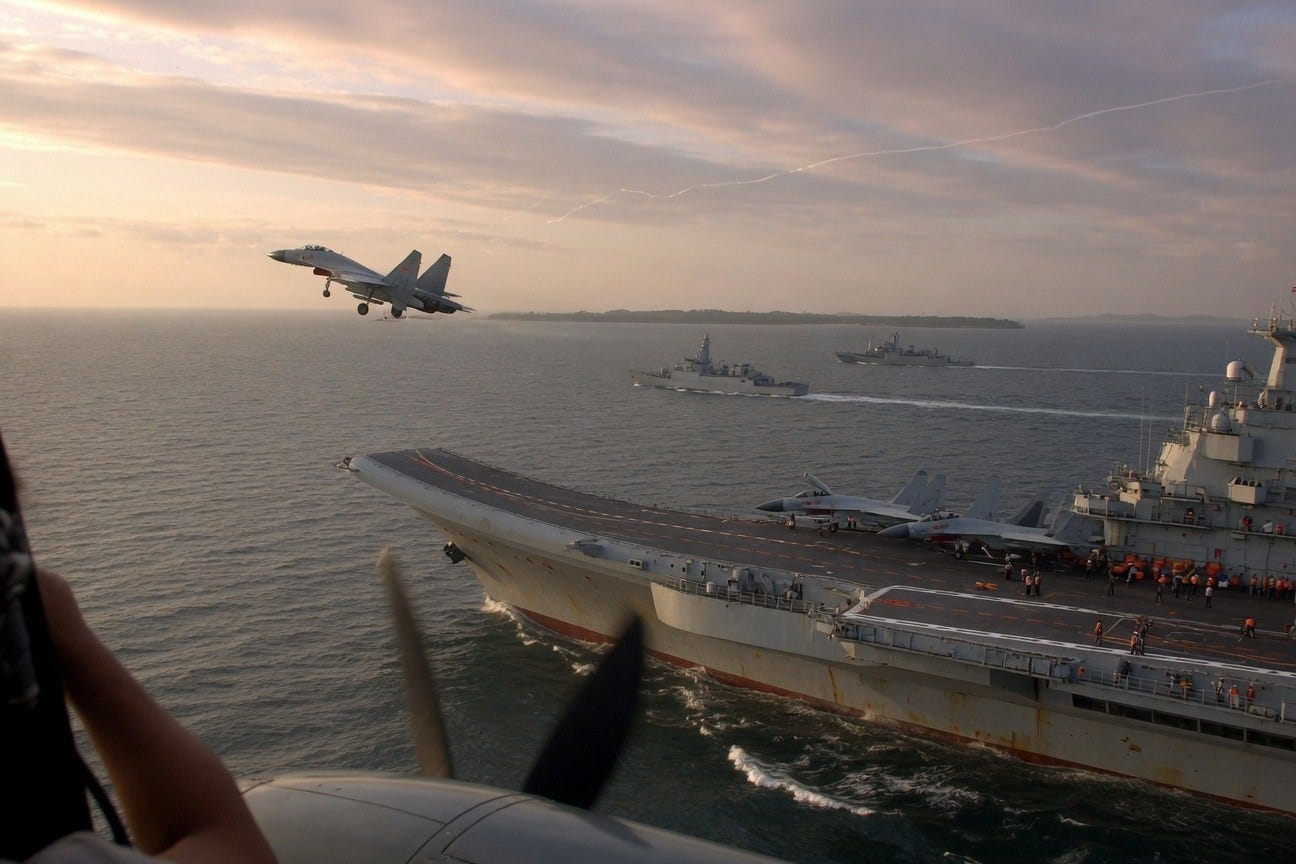
Japan's Joint Staff Office reported that the PLAN Liaoning carrier strike group conducted roughly 170 takeoffs and landings across three days in the Philippine Sea, east of Luzon. The daily breakdown, as tracked by the Japanese destroyer JS Asahi (DD-119), showed 80 take-offs and landings on May 26, followed by 50 on Wednesday and 40 on Thursday, according to USNI News. The strike group was built around the carrier CNS Liaoning and included one cruiser, one destroyer, one frigate, and a fast combat support ship, the vessel responsible for refueling and resupplying the formation at sea. Specifically, Japan identified the cruiser CNS Wuxi (104), the destroyer CNS Kaifeng (124), and the frigate CNS Luohe (545). That fast combat support ship is the logistical spine of the entire formation. Without it, the Liaoning group cannot operate for extended periods far from Chinese ports. The Philippine Sea sits roughly 1,200 nautical miles from China's nearest major naval base at Yulin on Hainan Island. Every hour on station burns fuel, spare parts, and aviation ordnance that must be replenished at sea or force a return to port. The sortie pattern itself is informative. The 80-sortie peak on May 26 dropped to 50 and then 40 over the following days. Several factors could explain this decline: a planned training taper, crew fatigue, aircraft maintenance cycles, supply constraints, or changing weather and sea conditions in the Philippine Sea, which can shift significantly day to day. None of these explanations is publicly confirmed. Japan's reporting, drawn from direct visual observation by JS Asahi, carries high confidence on the raw numbers. The explanation behind the decline remains open.
Tactical Map
Approximate area of interest: Estimated operating box for the Liaoning carrier strike group's recent 170 sorties east of Luzon, as monitored by Japan.
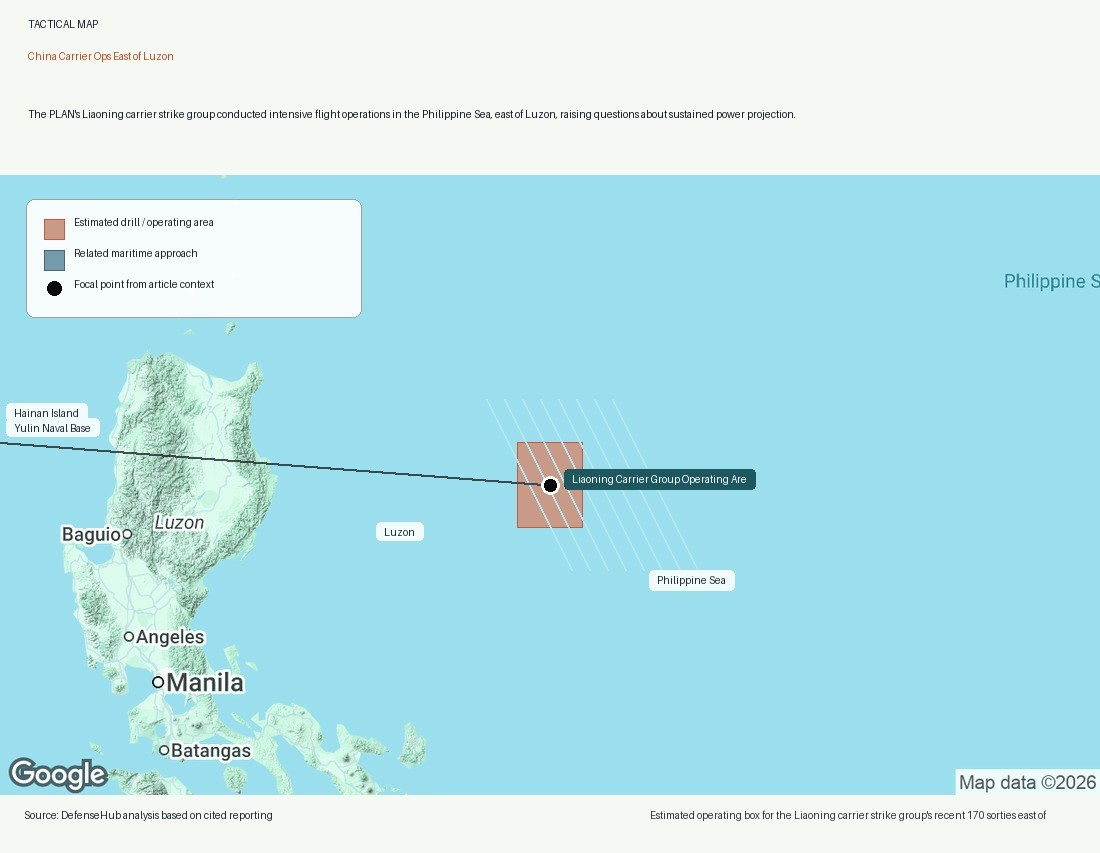
Map is illustrative and intended to orient the operational geography discussed below.
Operational Context
The Liaoning has operated in the Philippine Sea before, but 170 sorties in a single week represents a significant increase in demonstrated tempo. For comparison, a U.S. Nimitz-class carrier routinely generates 100-plus sorties per day during surge operations. The Liaoning's peak of 80 in a single day, using a ski-jump ramp that limits aircraft launch weight and fuel loads, shows real progress but still sits well below American benchmarks. This drill occurred in waters directly relevant to any Taiwan contingency. Operating east of Luzon positions a carrier group along the sea lanes that would carry U.S. reinforcements from Guam or the broader Pacific toward Taiwan. The geographic choice is consistent with a concept some analysts have described as a blocking position beyond the first island chain, though the exercise could also serve broader training objectives such as testing open-ocean carrier operations or demonstrating political resolve. Asserting with certainty that Beijing is rehearsing a specific operational plan goes beyond what a single exercise can confirm. The timing also follows months of intensifying Chinese military pressure around Taiwan and in the South China Sea, a pattern consistent with Beijing's broader signaling that it is building the operational capacity to act on its unification timeline if it chooses to do so. Japan's decision to shadow the group with JS Asahi and publicly release detailed sortie counts serves a dual purpose: intelligence collection and strategic transparency. Tokyo wants Beijing to know it is watching, and it wants Washington and Manila to have the data.
