

DefenseHub · Sunday — Military History · August 30, 2026
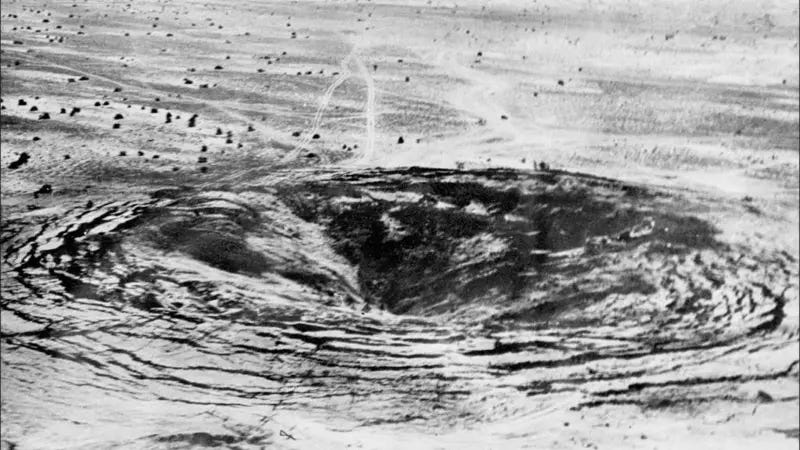
On May 18, 1974, just after 8:05 a.m., a team of roughly 75 Indian scientists detonated a plutonium implosion device buried 107 meters under the sands of Rajasthan. India claimed a yield of 12 to 13 kilotons; independent seismic estimates run lower, closer to 4 to 8. Indira Gandhi's government code named the operation "Smiling Buddha" and called it a "peaceful nuclear explosion," a label that let the country avoid formally declaring itself a nuclear power while quietly collecting the deterrent value of being one anyway (India Today; Nuclear Weapon Archive). That deliberate ambiguity was expensive: it cut India off from most international nuclear cooperation for more than two decades, and it did not stop the country from returning to the same desert 24 years later to say, plainly, that it had the bomb. More than five decades after that first test, India now runs a complete nuclear triad, land, sea, and air, with an arsenal the Stockholm International Peace Research Institute (SIPRI) puts at around 190 warheads. The question running through this story is not just how India built the bomb, but who that force is actually sized against today.
What We Know
India's nuclear program started as a science project before it became a weapons project. Homi Bhabha founded the Tata Institute of Fundamental Research in 1945, chaired the creation of the Atomic Energy Commission in 1948, and set up the Department of Atomic Energy in 1954. At the 1955 Geneva conference on peaceful uses of atomic energy, Bhabha laid out a three stage plan built specifically around India's resources: little natural uranium, but enormous thorium reserves meant to fuel reactors decades down the line (BARC; Anantam IAS). The stated goal was power generation, not weapons.

The calculation changed after the 1962 war with China and China's first nuclear test in 1964. From that point on, the scientific infrastructure Bhabha had built also became the foundation for a weapons option, even though the formal political decision took years to arrive.
That option became reality with the Smiling Buddha test at Pokhran. Scientist Pranab Rebatiranjan Dastidar pushed the firing button, and the Indian government stuck with the "peaceful nuclear explosion" label to preserve some diplomatic cover, even though the technical evidence pointed unmistakably to a weapons test (India Today; Nuclear Weapon Archive; Wikipedia).
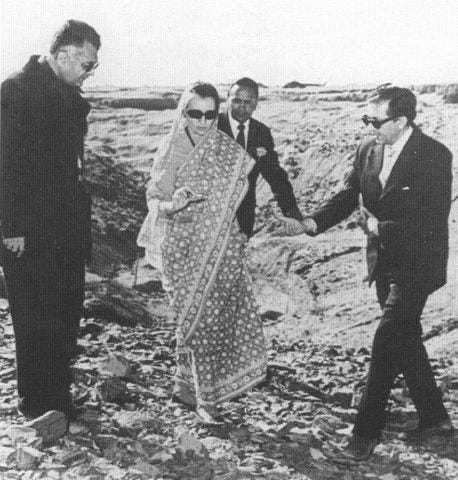
Canada suspended nuclear cooperation with India within days of the test, and a broader technology denial regime settled in, setting India's own civilian nuclear program back for nearly a decade. That stretch, later described by specialists as "the long pause," only ended formally with the 2008 US-India nuclear deal (Nuclear Weapon Archive; Annual Reviews; Model Diplomat).
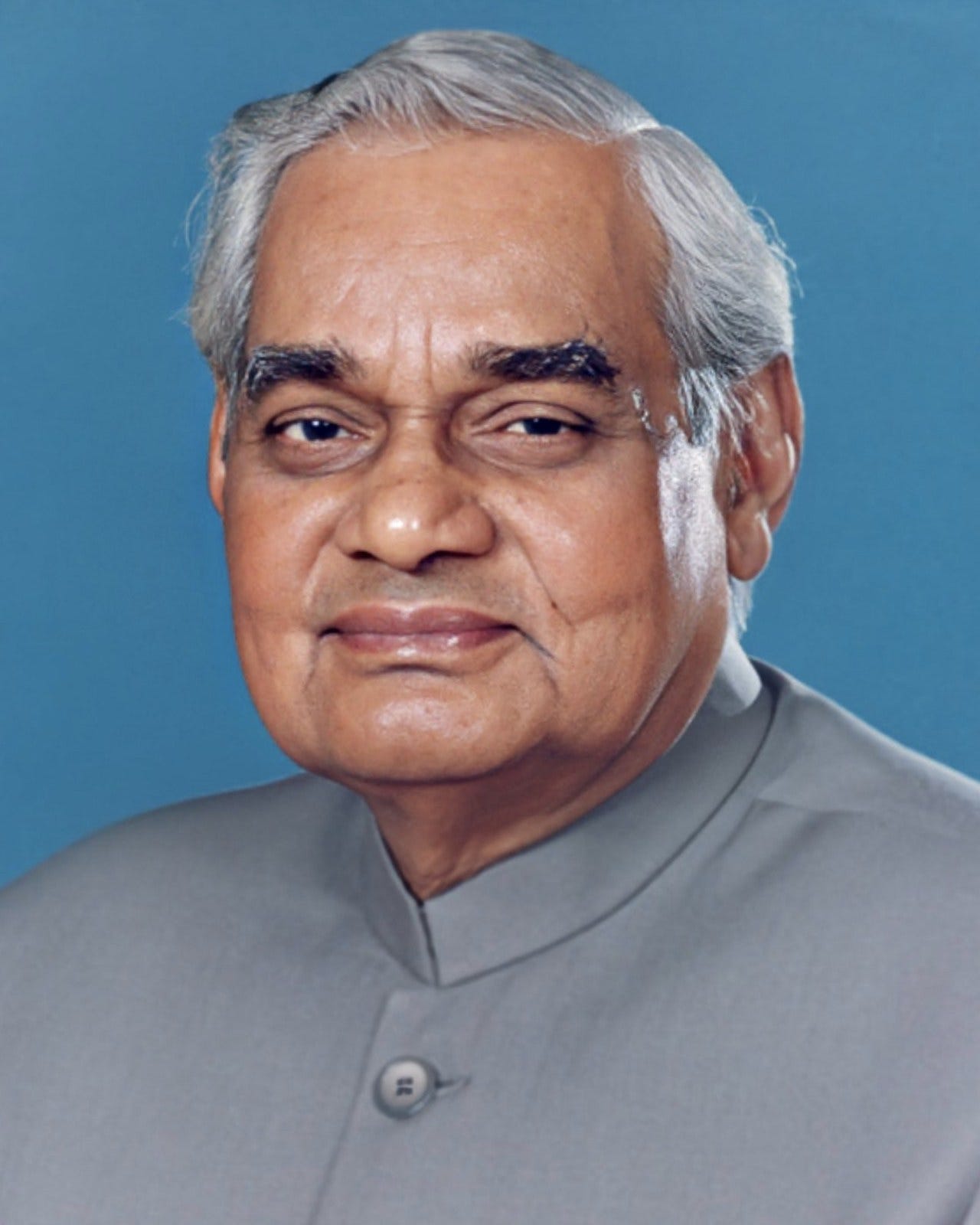
The ambiguity ended in May 1998. Under Prime Minister Atal Bihari Vajpayee, India detonated five devices over two days, May 11 and 13, at the same Pokhran range, under the code name Operation Shakti. The series included a two stage thermonuclear device with a declared yield of 45 kilotons, designed for a capability of up to 200 kilotons once fully developed. Unlike 1974, there was no euphemism this time: the government stated outright that India was a nuclear weapons state (Wikipedia; ORF; Indian Express).
See also: Tsar Bomba: The Most Powerful Thermonuclear Weapon Ever Tested
Operational Context
The 1998 declaration required a command structure India did not yet have. On January 4, 2003, the Cabinet Committee on Security formalized India's nuclear doctrine: credible minimum deterrence, no first use unless India or its forces are hit with nuclear weapons, or with large scale biological or chemical attacks, massive retaliation, and strictly civilian control through a Nuclear Command Authority split between a Political Council chaired by the prime minister and an Executive Council chaired by the National Security Adviser. The government created the Strategic Forces Command that same day, a tri service unit tasked with running the nuclear arsenal across the army, navy, and air force (Strategic Forces Command; PIB; CSIS).
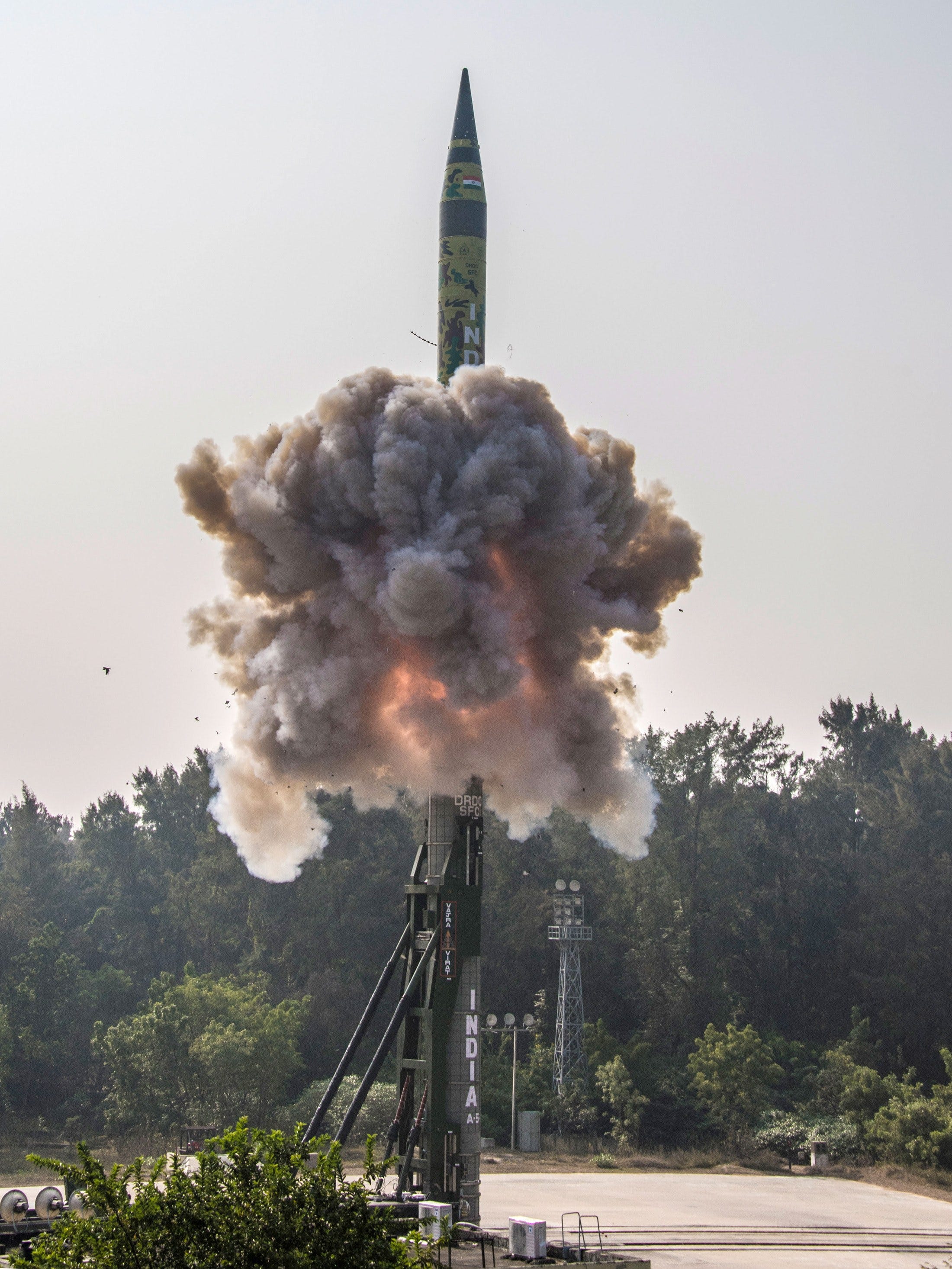
The land leg had already been building for years through the Agni missile family: the short range Agni-I (700 to 1,200 km, covering Pakistan), the Agni-II and Agni-III (2,000 to 5,000 km, reaching a growing share of China), and finally the Agni-V, an intercontinental class missile with a range between 5,000 and 8,000 km, fired from an armored mobile launcher. The jump in range from the first missile in the family to the last tells its own story about how much the underlying strategic problem grew (Wikipedia; CSIS Missile Threat).
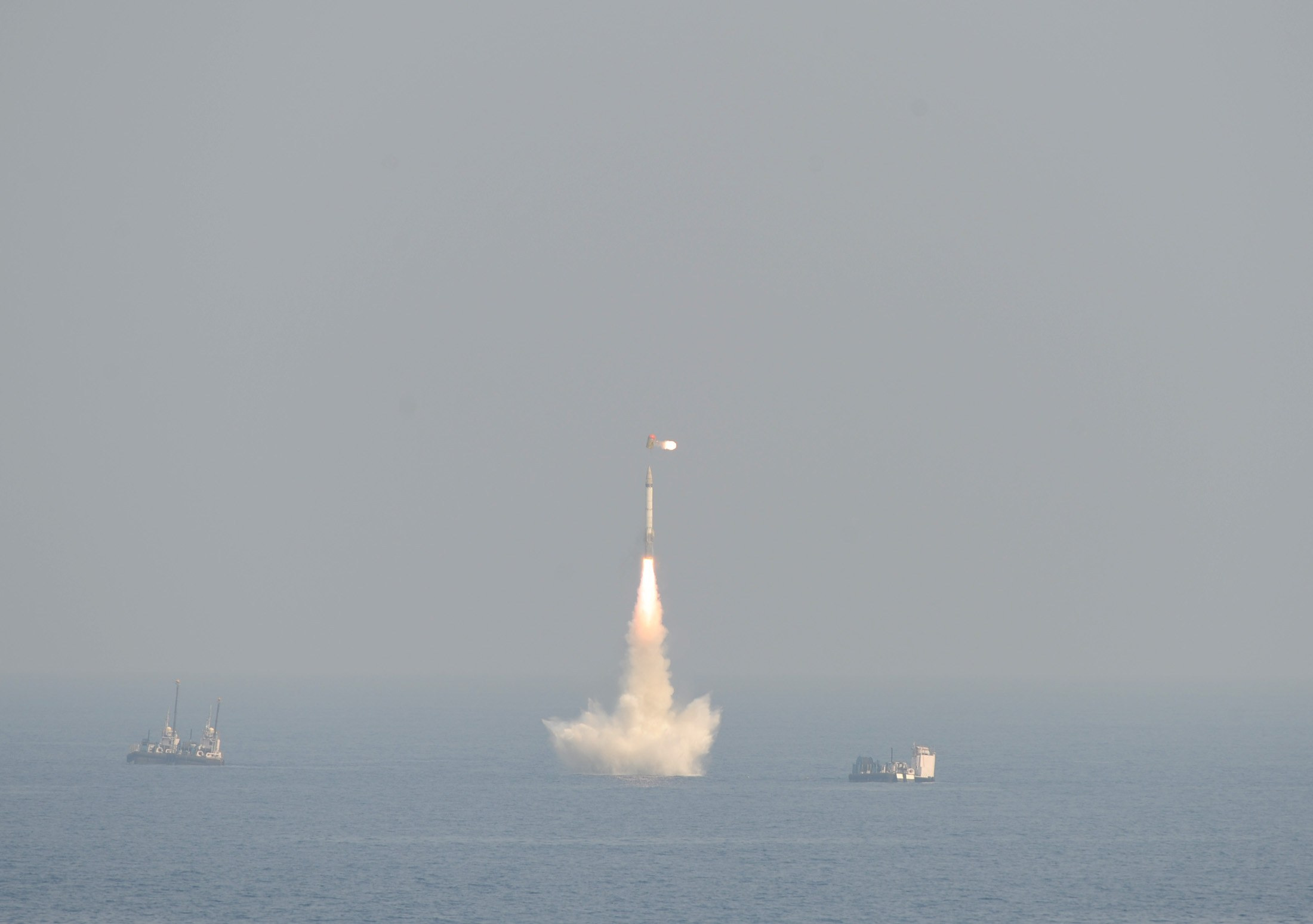
The sea leg took longer to matter. India's first nuclear submarine, INS Arihant, entered service around 2016 and was declared "fully operational" in November 2018, but it carried only the K-15 missile, limited to roughly 750 km. That forced the submarine to sail dangerously close to an adversary's coast for a launch to count for anything, undercutting the whole point of putting a deterrent at sea: the ability to survive a first strike from somewhere the other side cannot find you. The second boat, INS Arighaat, entered service in August 2024, and in December 2025 it test fired the K-4 missile, with a range extended to around 3,500 km, which made the K-15 largely obsolete as the backbone of a serious sea based deterrent. On April 3, 2026, a third submarine, INS Aridhaman, larger and more advanced than its predecessors, entered service, and analysts described that moment as when India's nuclear triad finally became fully functional across all three domains (Times of India; Newsweek; Eurasian Times; Carnegie Endowment).
See also: The Future of the U.S. Nuclear Shield
My Read
What strikes me most about this story is the gap between the paperwork and the hardware. The doctrine on the books still reads like it was written for a smaller, more hesitant country: a minimum deterrent, kept deliberately vague, leaning on land based missiles of modest range. That text has not changed since January 2003. Everything underneath it has. By 2026 India is running three functioning legs of a triad, has flight tested an intercontinental range missile carrying multiple independent warheads, and has watched its own stockpile climb from roughly 180 to 190 weapons in a single SIPRI reporting cycle. At some point the doctrine stops describing the force and starts lagging behind it.
I think the honest way to put it is that "India versus Pakistan" was always the comfortable explanation, and it is getting harder to square with the numbers. Once you get past the Agni-III, the Agni-V covers most of China, not just Pakistan, and the K-4 has that kind of reach too. I am not arguing Pakistan has dropped out of the equation, and no Indian official has stood up and said the arsenal is now sized for China. This is an inference from published ranges and test results, not a quote from anyone inside the planning process.
The strongest pushback I can imagine is simply that the doctrine has not moved an inch since 2003, and Indian officials go out of their way to keep talking about "credible minimum deterrence" rather than naming a specific rival. Both of those things are true, and I do not think they undercut the point so much as they are the point. Capability can grow quietly for years while the official vocabulary stays frozen, and the widening distance between the two is itself worth noticing, even without a press release to confirm it. What would settle this either way is a declared doctrine review, a leaked or published targeting document, or some Indian official finally saying out loud what the missile ranges already suggest. Until one of those shows up, what we have is a complete triad whose real logic can only be inferred, not confirmed.
When doctrine and capability begin to diverge, which should carry more weight: official policy, missile range, or the survivability of the submarine force?
What to Watch
An official review of no first use or credible minimum deterrence—not another op-ed.
Whether S5 submarines and further MIRV tests move from development into operational deployment.
How China and Pakistan respond through doctrine, deployments, or new tests.
If you value evidence-led analysis that separates official doctrine from operational capability, subscribe to DefenseHub.
Recommended Sources
Carnegie Endowment: The Coming of Age of India's Nuclear Triad: the sharpest available take on what INS Aridhaman's 2026 commissioning actually means strategically.
Nuclear Weapon Archive: India's Nuclear Weapons Program: a specialist technical reference on the 1974 Smiling Buddha test and the isolation that followed.
ORF: How India Was Forced to Conduct the Nuclear Tests of 1998: the strategic context behind Operation Shakti and India's formal nuclear weapons state declaration.
CSIS: India's Nuclear Doctrine: Need for a Review: a detailed walkthrough of the 2003 doctrine text and the recent push to update it.
Times of India: India Now Has 190 Nuclear Warheads: coverage of SIPRI's latest estimate of the size of India's arsenal.
Sources & Methodology
This briefing is based on open-source reporting, official releases, procurement documents, defense-industry disclosures, and specialist analysis available at publication time. Claims involving battlefield effects, classified programs, or active operations are treated cautiously unless corroborated by multiple independent sources.
DefenseHub prioritizes primary sources where available, including official releases, budget and procurement records, legislative documents, technical disclosures, institutional research, and reputable reporting.
Corrections or source clarifications can be sent through the DefenseHub contact page.
— R. Planche · DefenseHub
Great piece! I’ve always found the nuclear proliferation competition between India and Pakistan fascinating, definitely learned a few things from this article :)