

DefenseHub · Saturday · Tactics · June 13, 2026
The IDF's combined arms assault into Gaza after 7 October 2023 produced a specific, sequenced tactical model for urban combat that many Western armies would struggle to replicate at comparable scale. That gap matters because allies that lack the doctrine, equipment, and trained engineers to fight in cities may not be able to sustain the deterrent commitments they claim to provide.
What We Know
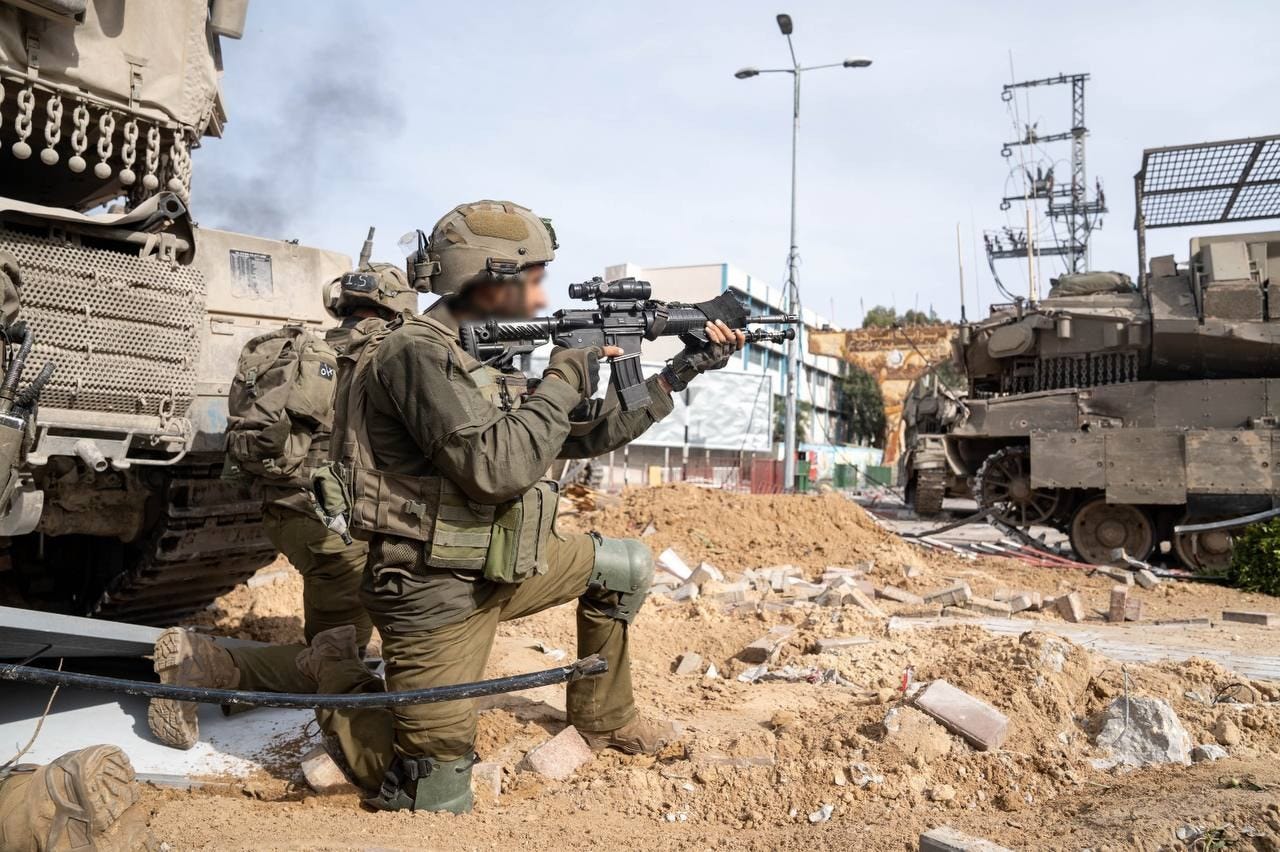
According to a RUSI analysis of IDF operations in Gaza, the assault into densely built urban terrain followed a recurring five-part combined arms sequence, as reconstructed by RUSI, with each element intended to protect the forces behind it. First, D9 armored bulldozers pushed ahead of the main force by one short advance, physically smashing through barriers and rubble to open a path. Second, Merkava main battle tanks moved forward in pairs to take up positions where they could cover the next stretch of terrain with direct fire. Third, Namer heavy armored personnel carriers built on the same chassis as the Merkava, rolled forward under that protective fire umbrella. Fourth, infantry dismounted from the Namers and entered buildings on either side of the next objective, clearing threats from inside the structures rather than advancing exposed on streets. Fifth, light infantry followed to secure and hold the cleared ground, preventing Hamas from reoccupying it. Execution varied block by block and many of the formations were ad hoc, but the recurring approach addressed a specific problem: Hamas had extensively prepared Gaza's urban terrain to support protracted defensive operations, including tunnel networks protected by improvised explosive devices (IEDs).
This assessment draws from RUSI reporting produced with IDF cooperation and direct observation, which gives it strong tactical detail but also means the source had an interest in shaping the narrative. The operational sequence itself is well documented and corroborated by open-source imagery and independent reporting. Judgments about its effectiveness carry more uncertainty, as discussed below. The critical enabler was the combat engineer. Dismounted engineers became, in RUSI's description, an integral element of all combined arms operations. They performed explosive ordnance disposal (EOD), breached walls and rooms to allow unpredictable movement through buildings, and reduced exposure to traps. Without them, the entire sequence stalls. Infantry cannot safely dismount. Tanks lose their supporting arms.
The bound-by-bound advance becomes a casualty funnel. A question many readers will ask: did this model actually reduce IDF casualties, or did it simply keep the operation moving at an acceptable cost? The honest answer is that we do not yet have the data to say clearly. The IDF has reported significant losses in Gaza, including among armored crews and engineers, and has not published the kind of granular casualty-by-phase data needed to evaluate whether the five-step sequence reduced losses compared to alternative approaches. What the available reporting does support is that the model sustained operational tempo through extremely dense and heavily trapped terrain without the kind of catastrophic unit losses that would halt an advance. Whether that means it was casualty-efficient or simply casualty-tolerant remains an open question until more detailed after-action data emerges.
Tactical Map
Approximate area of interest: D9s clear paths, tanks cover, Namers advance, then infantry clears buildings and secures ground in a methodical sequence.
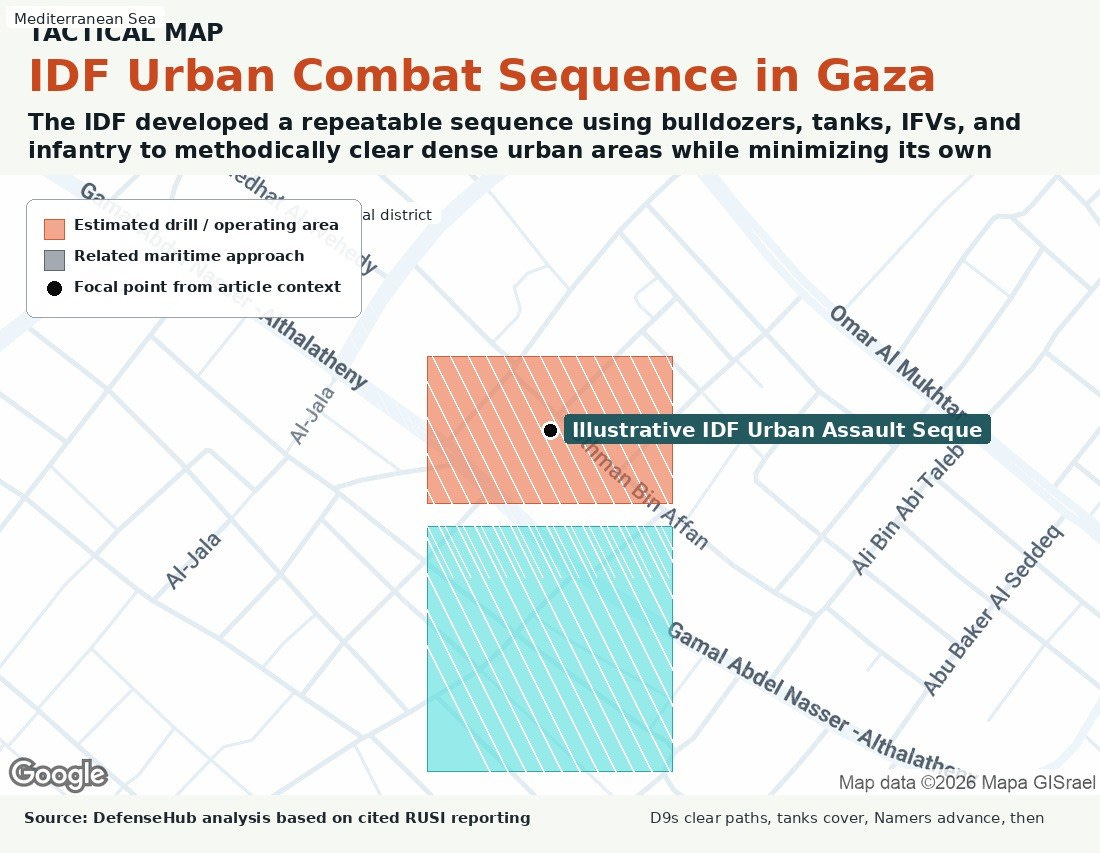
Map is illustrative and intended to orient the operational geography discussed below.
Operational Context
The IDF launched this assault while simultaneously managing what it described as a more severe threat from Hezbollah on its northern border. That two-front pressure forced a rapid tempo. The urban assault was not a siege; it was a deliberate, fast-moving combined arms penetration into prepared defenses. The choice to move quickly rather than encircle and starve was itself a strategic decision shaped by the hostage crisis and the political clock. For NATO armies, this is directly relevant. British defence figures have repeatedly warned that the current period resembles a pre-war environment. RUSI explicitly frames the Gaza lessons as applicable to British Army readiness.
The problem is structural: most NATO ground forces have reduced their combat engineer capacity over decades of counterinsurgency and peacekeeping. The IDF's model depends on engineers at the tactical edge of every maneuver element, not concentrated in specialist battalions held at brigade level. This connects to a broader pattern visible across multiple theaters. Just as D-Day's legacy highlights the enduring challenge of combined arms assault against prepared defenses, Gaza 2023 shows that the fundamentals have not changed. What has changed is the density of the urban environment, the sophistication of subterranean defenses, and the political constraints on operations among civilian populations.
