

DefenseHub · Tuesday · Highlights · July 7, 2026
By R. Planche · Chief Editor & OSINT Curator
Kim Jong Un's decision to personally watch a weapons test from a warship that had failed badly enough at its own launch ceremony last year to need months of repair is itself part of the message North Korea wants understood. Kim stood on a North Korean shoreline last week watching his navy fire what state media describes as a nuclear-capable cruise missile from the Kang Kon, the same destroyer damaged during that earlier launch. AP News first reported the tests, corroborated by The Washington Post, The Jerusalem Post, and Military.com
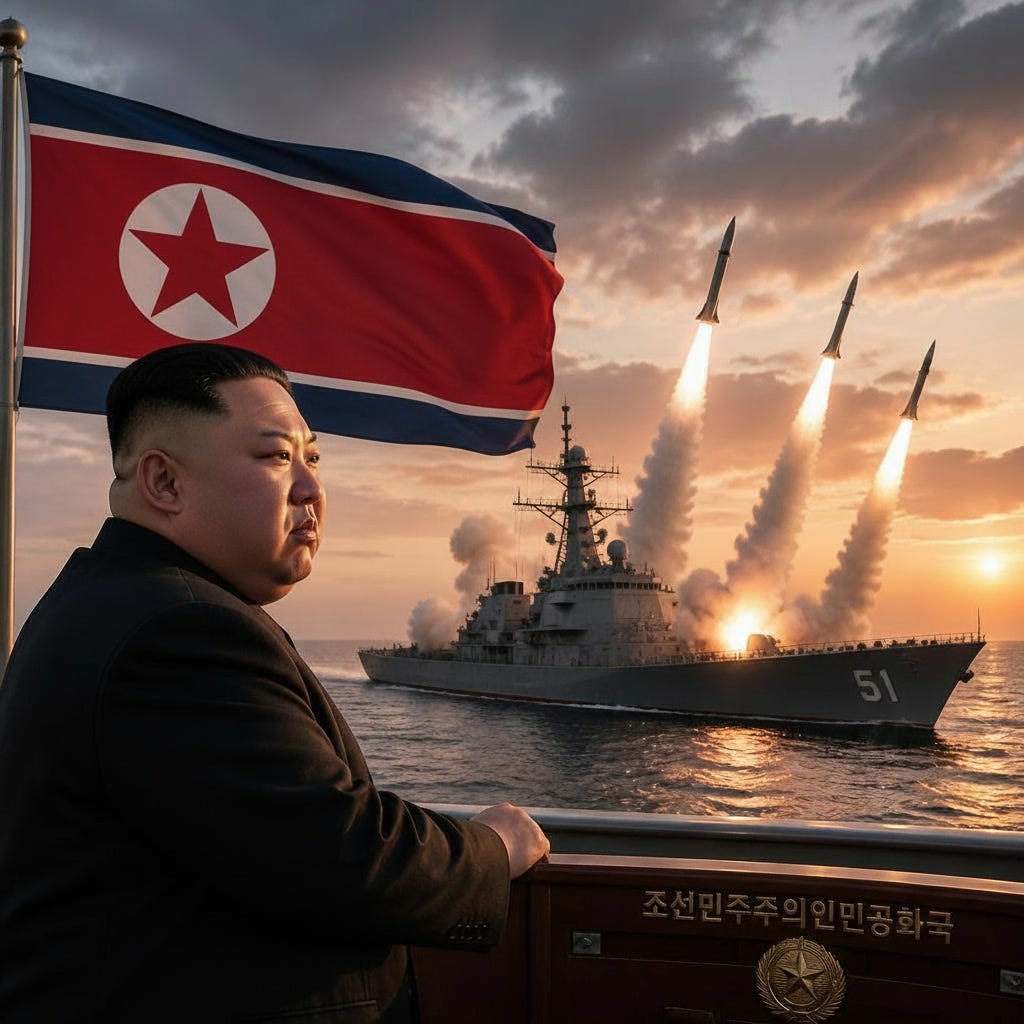
Conceptual illustration of Kim Jong Un watching a North Korean warship conduct missile tests.
What We Know
North Korean state media, KCNA, reported Sunday that Kim supervised a weapons assessment aboard the Kang Kon on Friday, per AP News, The Washington Post, The Jerusalem Post, and Military.com. KCNA described the event as including test-firing of what it called a strategic cruise missile capable of carrying a nuclear warhead, though that capability comes from North Korean state media's own characterization and has not been independently verified. The tests also included live fire from the destroyer's main gun and automatic cannons, electronic warfare trials, and evaluations of the ship's target-detection and information-processing systems.
The Jerusalem Post additionally reported evaluations of anti-ship, anti-submarine, and air defense systems. Kim did not board the vessel. He watched from shore, then ordered officials to finish the Kang Kon's trials and put it into active service within two months, according to AP News. The Kang Kon is a 5,000-ton destroyer, the same displacement class as North Korea's other new warship, the Choe Hyon, which was unveiled in April 2025 and commissioned in a lavish ceremony in late June, where Kim declared his navy's nuclear armament was proceeding as planned.
The Kang Kon, by contrast, was damaged in a failed launch ceremony last year and required repair before it could reach this stage. Kim has framed both destroyers as proof his navy's operational reach and preemptive strike capabilities are expanding, per KCNA language cited by AP News and The Washington Post. That framing sits alongside his broader naval push: construction of a nuclear-powered submarine and, per his five-year military goals announced at February's Workers' Party congress, a call for intercontinental ballistic missiles capable of underwater launch.
The destroyer program is one piece of a larger buildup, not an isolated showpiece.
Operational Context
AP News describes the Choe Hyon as North Korea's first 5,000-ton destroyer and the Kang Kon as a new destroyer of the same class, which indicates this tonnage represents new ground for Pyongyang's navy rather than a routine addition to an existing fleet. The jump to destroyer-class hulls carrying anti-air, anti-ship, and what KCNA calls nuclear-capable missile suites, a claim made for both the Choe Hyon and the Kang Kon, is a genuine step up in stated ambition, even if the warhead claims themselves rest on North Korean reporting rather than outside confirmation.
Kim's February congress goals, including underwater-launch ICBMs and a nuclear submarine, suggest the destroyers are meant as one visible piece of that wider agenda rather than a standalone project. The Kang Kon's damage happened at its own launch, before it ever deployed. That is a different kind of setback than a fielded system struggling to sustain operations later, and it raises a question about the shipyard and integration process itself, not just about how the ship performs once in service.
A two-month window from repair to full commissioning is short next to the roughly fourteen months the Choe Hyon took from unveiling to commissioning. But the two ships started from different places: the Choe Hyon was a new build going through its first full process, while the Kang Kon is a repaired hull resuming a process already underway before its accident. That difference alone could explain part of the gap, so the comparison should be read as a data point rather than settled evidence of confidence or pressure.
🇰🇵 OSINT Radar | Direct Translation from North Korea:
"Kim Jong Un observed tests of weapons on a destroyer and supervised tests of major weapons organized by defense institutes. The events occurred in 2026...."
