

Based on research by James Scouras, Lauren Ice, and Megan Proper
The Johns Hopkins University Applied Physics Laboratory · 2024 · National security report
Why It Matters
A 2024 Johns Hopkins APL report argues that U.S. policymakers give too little attention to the possible climatic consequences of nuclear war. Soot from burning cities could reach the upper atmosphere, reduce sunlight, cool the planet, disrupt harvests, and cause famine far beyond the belligerents. The mechanism is plausible, but the scale remains uncertain because estimates depend heavily on urban fuel loads, fire behavior, and smoke lofting. The authors call for sustained research and for these risks to be considered in deterrence and contingency planning.
Key Findings
U.S. government interest and funding declined sharply after the Cold War. The report says government attention remained low after research revived in the 2000s, while much of the funding shifted toward private and nongovernmental sources.
Major uncertainties remain, especially over how much fuel would burn in modern cities, how much soot the fires would produce, and how high that smoke would rise.
Studies of regional India-Pakistan exchanges have reached different conclusions. A 2018 Los Alamos study estimated mostly regional effects, while other models projected substantial global cooling. The studies use different assumptions and should not be treated as identical scenarios.
The authors argue that the debate has long mixed scientific disputes with nuclear-policy positions, making uncertainty harder to resolve and easier to use selectively.
The 2024 report called for federally funded research. A 2025 National Academies consensus report subsequently identified major data and modeling gaps and recommended coordinated federal research and model-intercomparison projects.
A Threat Forgotten and Revived
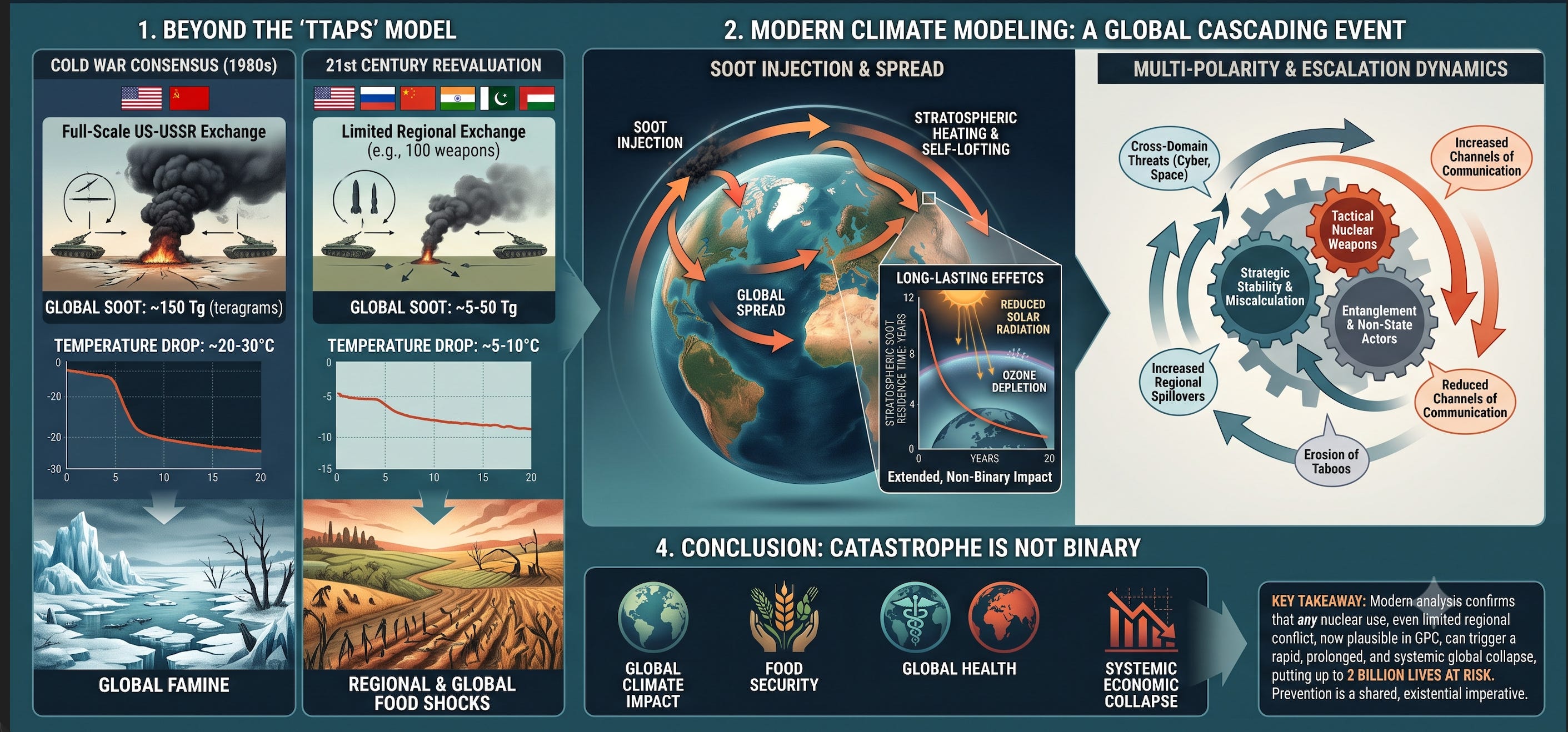
The term "nuclear winter" entered public and scientific debate in 1983 with the TTAPS paper, which modeled how smoke from a large U.S.-Soviet nuclear exchange could cause severe global cooling. According to the APL report, research and policy attention expanded rapidly during the 1980s, then declined sharply after the Cold War.
The report identifies a revival beginning in 2007. Much of the new work shifted from a massive superpower exchange to more limited regional wars, especially between India and Pakistan. These studies found that exchanges involving roughly 100 weapons could affect climate beyond the belligerents, but their estimates of scale and duration differed substantially.
The 2024 authors argue that too little recent work examines China-inclusive or present-day NATO-Russia scenarios. This is a gap in scenario coverage, not an absence of great-power modeling: modern studies of a large U.S.-Russia exchange do exist.
The Unsettled Science
The nuclear-winter hypothesis describes a causal chain: nuclear detonations ignite urban fires; the fires generate black carbon, or soot; strong convection can carry some of it into the upper atmosphere; and the soot can spread, absorb sunlight, and cool the surface. The broad mechanism is plausible, but the magnitude depends on uncertain processes at every stage.
The largest disputes concern urban fuel loading, the extent and behavior of post-detonation fires, the amount and properties of the smoke, its injection height, and its atmospheric lifetime. Nuclear-war scenarios cannot be tested directly, so researchers rely on observations of related phenomena, laboratory work, and complex simulations.
A 2018 Los Alamos study estimated modest, mostly regional climatic effects for its India-Pakistan case. Other groups, using different fire, soot, and lofting assumptions, projected stronger and longer global cooling. The disagreement shows how sensitive the results are to assumptions; it is misleading to call the modeled cases exactly the same scenario.
🎥 Archival footage of the 1954 Castle Bravo test, the largest U.S. nuclear test, with a yield of about 15 megatons. Included as historical context.
Policy, Politics, and a Path Forward
The authors attribute the decline in official attention to several factors: the lower perceived risk after the Cold War, the politicization of the debate, competing research priorities, and disagreement over policy responses such as deep nuclear reductions. These are the report's interpretations of the historical record, not settled causal findings.
In its 2024 assessment, the report warned that renewed competition with Russia and China made continued official inattention harder to justify. Its authors viewed the 2021 congressional mandate for a National Academies study as limited rather than government-wide interest. That study was published in 2025. It confirmed extensive uncertainties and recommended coordinated research, including model comparisons, but its publication alone does not show that climate effects have been integrated into nuclear policy.
The APL report recommends a sustained, federally funded research program and further policy analysis on the relationship between deterrence, stability, and possible climatic effects. Its core argument is that uncertainty is a reason to improve the evidence base, not a reason to exclude the risk from planning.
Where the Evidence Is Uncertain
Important gaps include relatively limited analysis of present-day U.S.-China and NATO-Russia scenarios, even though modern U.S.-Russia modeling exists; poorly characterized fuel loads in contemporary cities; uncertain urban-fire behavior; and uncertainty over how much soot reaches and remains in the stratosphere.
What to Monitor
Whether U.S. agencies implement the 2025 National Academies recommendations for coordinated research and model comparisons.
New studies using current, China-inclusive and NATO-Russia scenarios, with assumptions that can be compared across models.
Defense or Energy Department documents that explicitly incorporate possible climatic effects into deterrence, contingency planning, or resilience policy.
About This Document
"WHATEVER HAPPENED TO NUCLEAR WINTER?" - James Scouras, Lauren Ice, and Megan Proper
The Johns Hopkins University Applied Physics Laboratory · 2024 · National security report
Copyright © 2024 The Johns Hopkins University Applied Physics Laboratory LLC. All rights reserved. Publicly accessible PDF.
Selected Sources
Whatever Happened to Nuclear Winter? - Scouras, Ice, and Proper, Johns Hopkins APL, 2024.
Potential Environmental Effects of Nuclear War - National Academies, 2025.
Nuclear Winter: Global Consequences of Multiple Nuclear Explosions - Turco et al., 1983.
Nuclear Winter Responses to Nuclear War Between the United States and Russia - Coupe et al., 2019.
Climate Impact of a Regional Nuclear Weapons Exchange - Reisner et al., 2018.
Examining the Climate Effects of a Regional Nuclear Weapons Exchange - Wagman et al., 2020.
This briefing was curated and summarized by DefenseHub from "WHATEVER HAPPENED TO NUCLEAR WINTER?", by James Scouras, Lauren Ice, and Megan Proper, published by The Johns Hopkins University Applied Physics Laboratory in 2024. Findings and underlying research remain attributable to the original authors and publisher.