

DefenseHub · Monday · Geopolitics · October 5, 2026
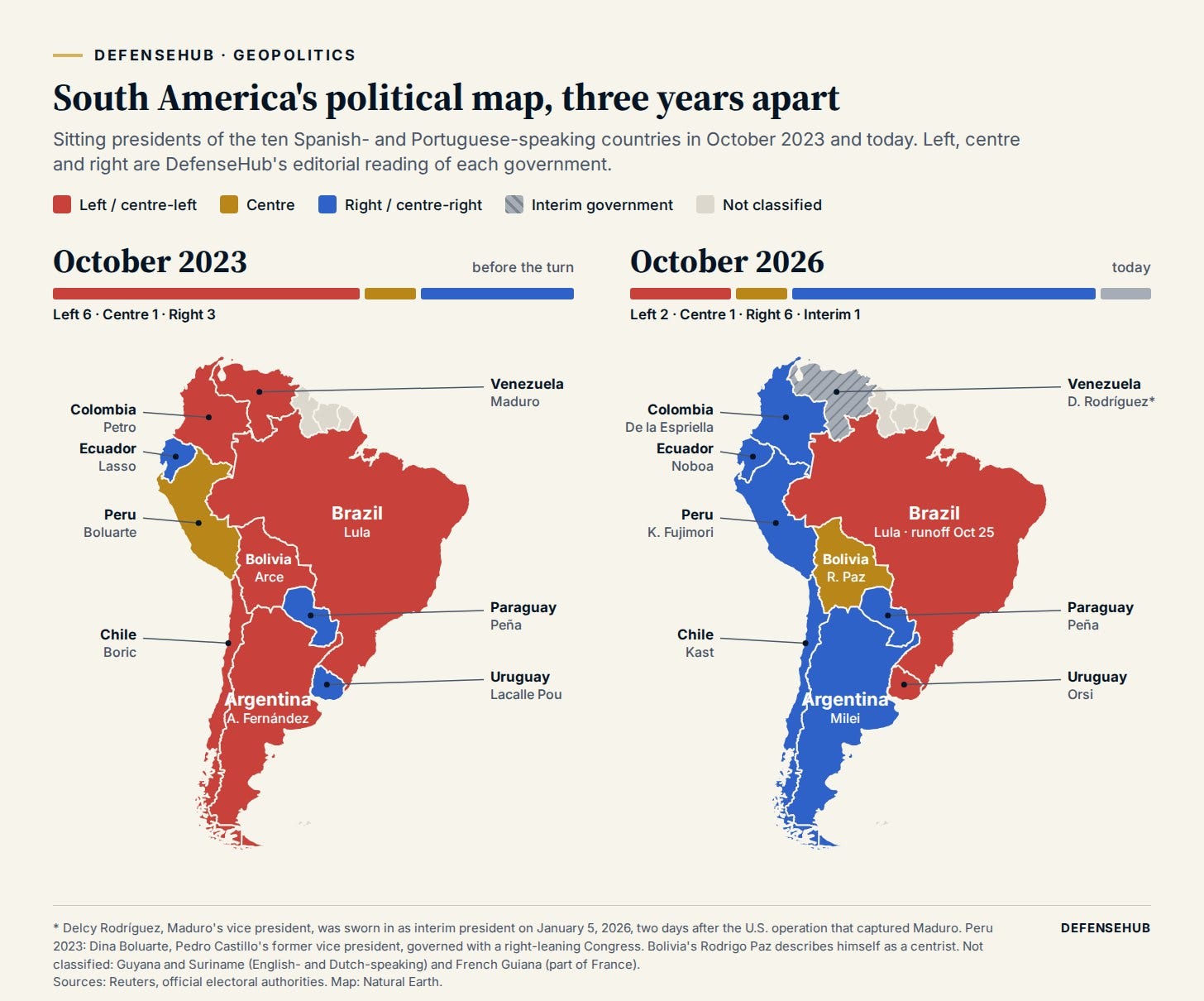
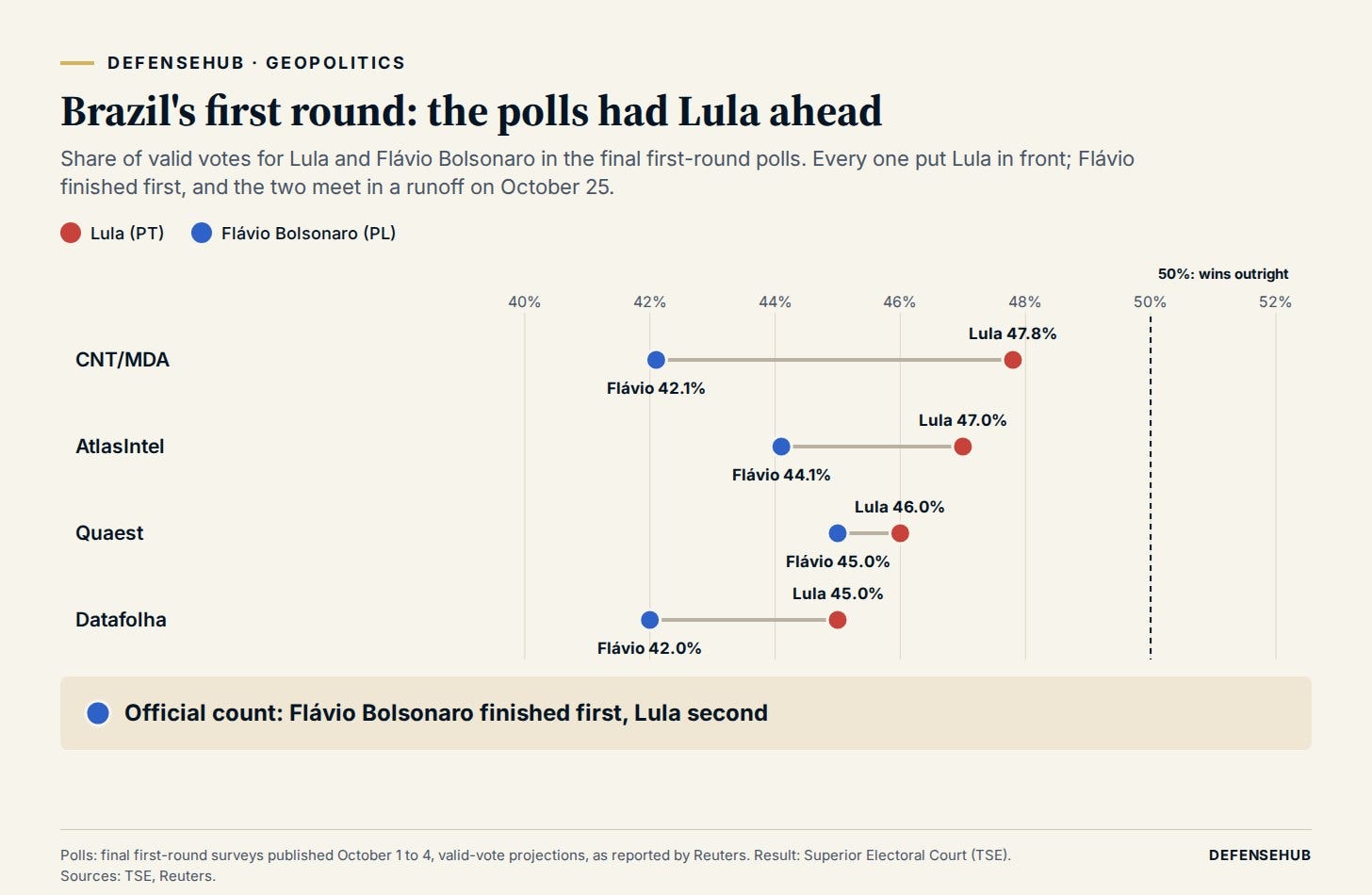
In October 2023 the map of South America was mostly red. Lula governed Brazil, Gustavo Petro governed Colombia, Gabriel Boric governed Chile, the Movement for Socialism had run Bolivia for almost two decades, Peronism held Argentina and Nicolás Maduro held Venezuela. Three years later Javier Milei runs Argentina, José Antonio Kast runs Chile, Keiko Fujimori runs Peru, Abelardo de la Espriella runs Colombia, Daniel Noboa has been reelected in Ecuador, and the Movement for Socialism took barely 3% in Bolivia. Maduro is in a New York jail. Yesterday Brazilians voted in the first round of the last big election of the cycle. Flávio Bolsonaro finished first, ahead of Lula and contrary to every final poll, and the two meet in a runoff on October 25. (TSE; Reuters; Reuters)
What We Know
The turn came country by country, and almost always by a clear margin. Milei won Argentina's runoff in November 2023 with nearly 56% and then won the October 2025 midterms with about 41% nationally against 32% for the Peronists. Noboa beat Luisa González, the candidate of former president Rafael Correa's movement, twice, in 2023 and again in April 2025. In Bolivia the MAS, which had governed since 2006, collapsed to 3.16% in the August 2025 first round amid fuel and dollar shortages; the centrist Rodrigo Paz won the runoff with 54.5%. Kast won Chile's December 2025 runoff with about 58% and took office in March. Fujimori won Peru by 49,641 votes in June 2026, and de la Espriella, a law-and-order newcomer, edged out the leftist Iván Cepeda in Colombia the same month, 49.66% to 48.70% on the initial count. (Reuters; Reuters; Reuters; Reuters; Reuters)
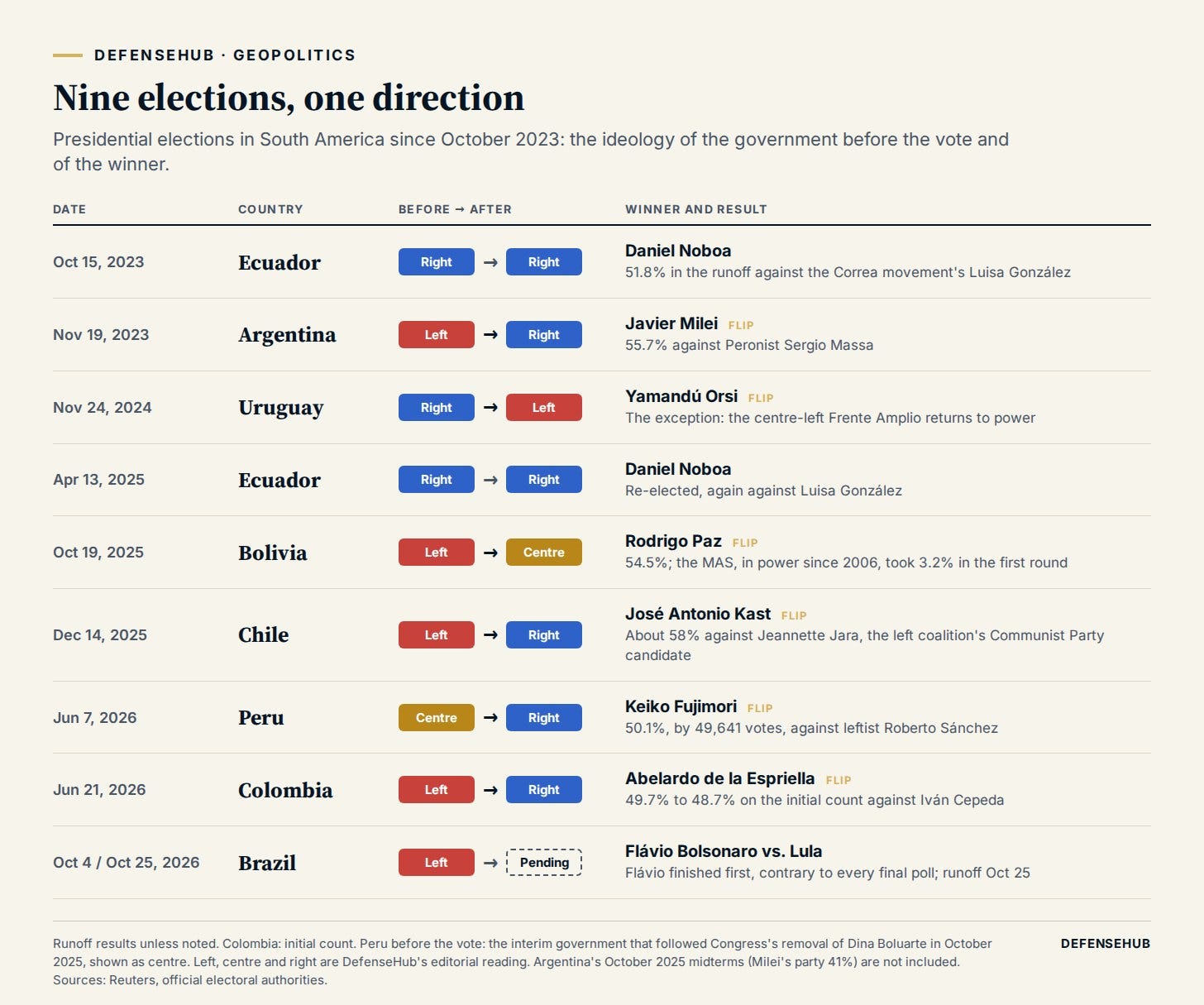
The wave is not uniform. Uruguay moved the other way in November 2024 and elected the center-left Yamandú Orsi, and Paraguay's Santiago Peña was already on the right. Paz in Bolivia calls himself a centrist, not a conservative. What the winners share is less an ideology than a list of grievances: crime, inflation, and the record of the governments they replaced.
That record includes court judgments, not only accusations. Argentina's Supreme Court upheld Cristina Fernández de Kirchner's six-year sentence for fraud in public road contracts in June 2025, with a lifetime ban from office; she is serving it under house arrest, a court ordered the seizure of assets tied to roughly $500 million in damages, and she is on trial in a second bribery case alongside 86 codefendants. Rafael Correa, Ecuador's former president, was convicted in absentia in the 2020 Sobornos bribery case and lives in Belgium. Peru's Pedro Castillo was sentenced to eleven and a half years in November 2025, a conviction for rebellion over his attempt to dissolve Congress. (Reuters; Reuters; Reuters)
Brazil's case is more tangled, and it should be stated precisely. Lula's convictions in Lava Jato, the Car Wash bribery probe, were annulled in 2021 on jurisdictional grounds, which restored his rights but was not an acquittal on the merits. The scandal of his third term is the pension fraud uncovered by the Federal Police in April 2025: an estimated R$6.3 billion deducted from retirees' benefits between 2019 and 2024 by associations, many without authorization. The period covers both Bolsonaro's government and Lula's. One of the entities with the largest deductions, about R$507 million, is Sindnapi, a retirees' union where Lula's brother José Ferreira da Silva holds a senior post; he has not been charged. The social security minister left office, and the congressional inquiry closed in March 2026 without approving a final report. (G1; G1; Agência Brasil)
The questions have also reached the Supreme Federal Court, the body that convicted Bolsonaro. In September 2023 Justice Dias Toffoli threw out all evidence from Odebrecht's leniency deal, the backbone of the Car Wash cases, and called Lula's imprisonment one of the greatest judicial errors in the country's history; in December he suspended the R$10.3 billion fine that J&F, the owner of meatpacker JBS, had agreed to pay over bribery. Then came Banco Master, liquidated by the Central Bank in November 2025 after its owner, Daniel Vorcaro, was arrested in a fraud investigation. O Globo reported that the law firm of Justice Alexandre de Moraes's wife had a contract with the bank worth R$3.6 million a month, about R$129 million over three years, to represent it before the Central Bank, the tax authority and Congress. In September the paper reported that Moraes reviewed the contract before it was signed; the firm says the work was carried out. Toffoli was assigned Vorcaro's appeal on November 28 and the next day flew to the Libertadores final in Lima on a private jet that also carried a lawyer for a Master executive. Nothing published shows that either the contract or the flight influenced a ruling, no justice has been charged with wrongdoing, and the court's defenders say the Odebrecht and J&F rulings corrected real abuses by Car Wash prosecutors. (UOL/Reuters; Reuters; Reuters; O Globo; O Globo; Correio Braziliense)
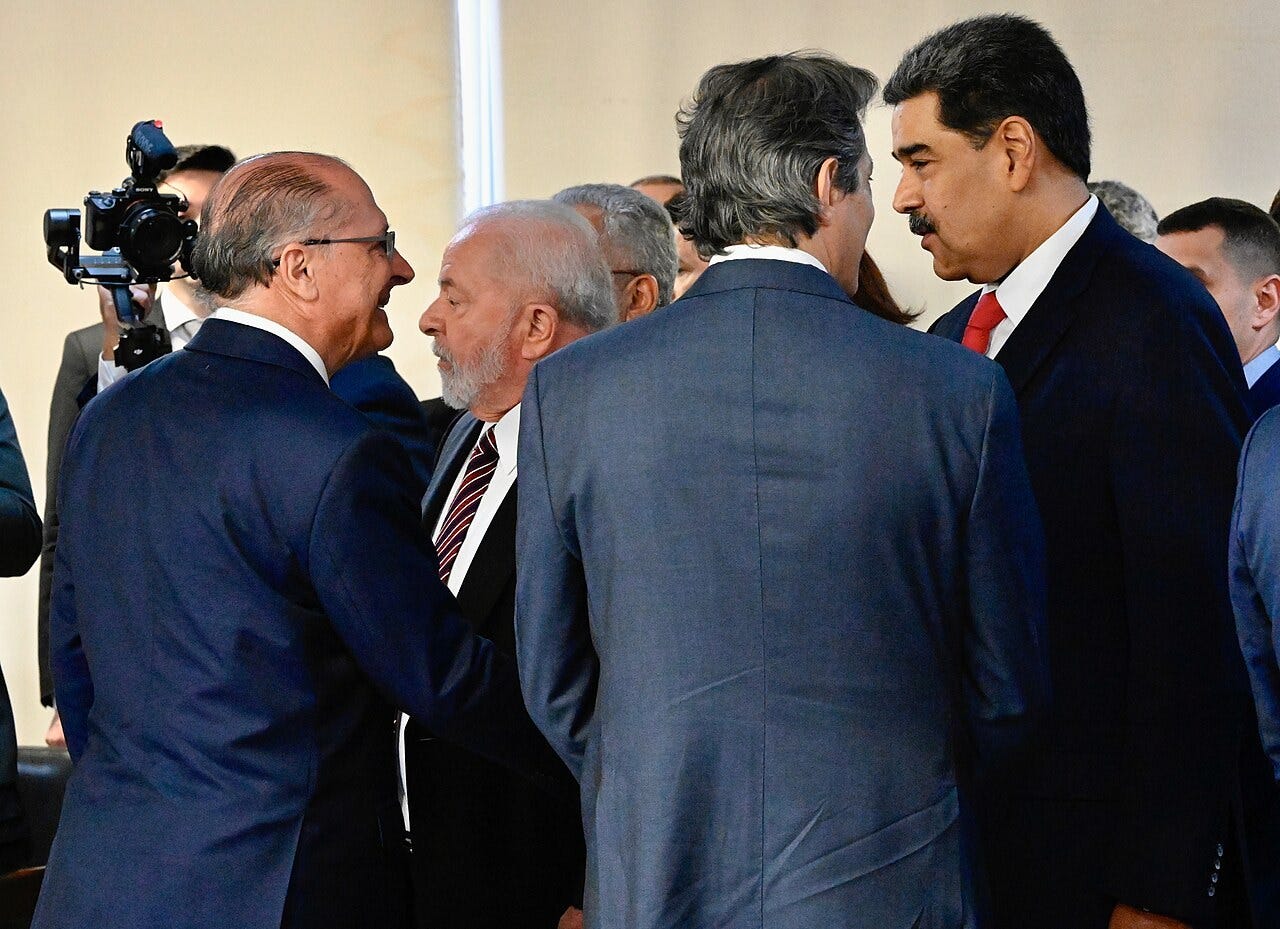
Foreign policy was the other half of the case against the left. In May 2023 Lula received Maduro in Brasília and told him the criticism of Venezuela was a "narrative" he should work to change; the rebuke came from Boric, a leftist, and from Uruguay's Luis Lacalle Pou. As a candidate in 2022 he told Time that Volodymyr Zelensky was as responsible for the war as Vladimir Putin, and in May 2025, as president, he stood at the Victory Day parade in Moscow. Brazil also refused to recognize Maduro's claimed win in July 2024 and declined to join China's Belt and Road Initiative. Petro's Colombia signed up to it in May 2025, six months after Xi Jinping inaugurated the Chinese-built port of Chancay in Peru. (Reuters; Reuters; The Moscow Times; Reuters; Reuters)
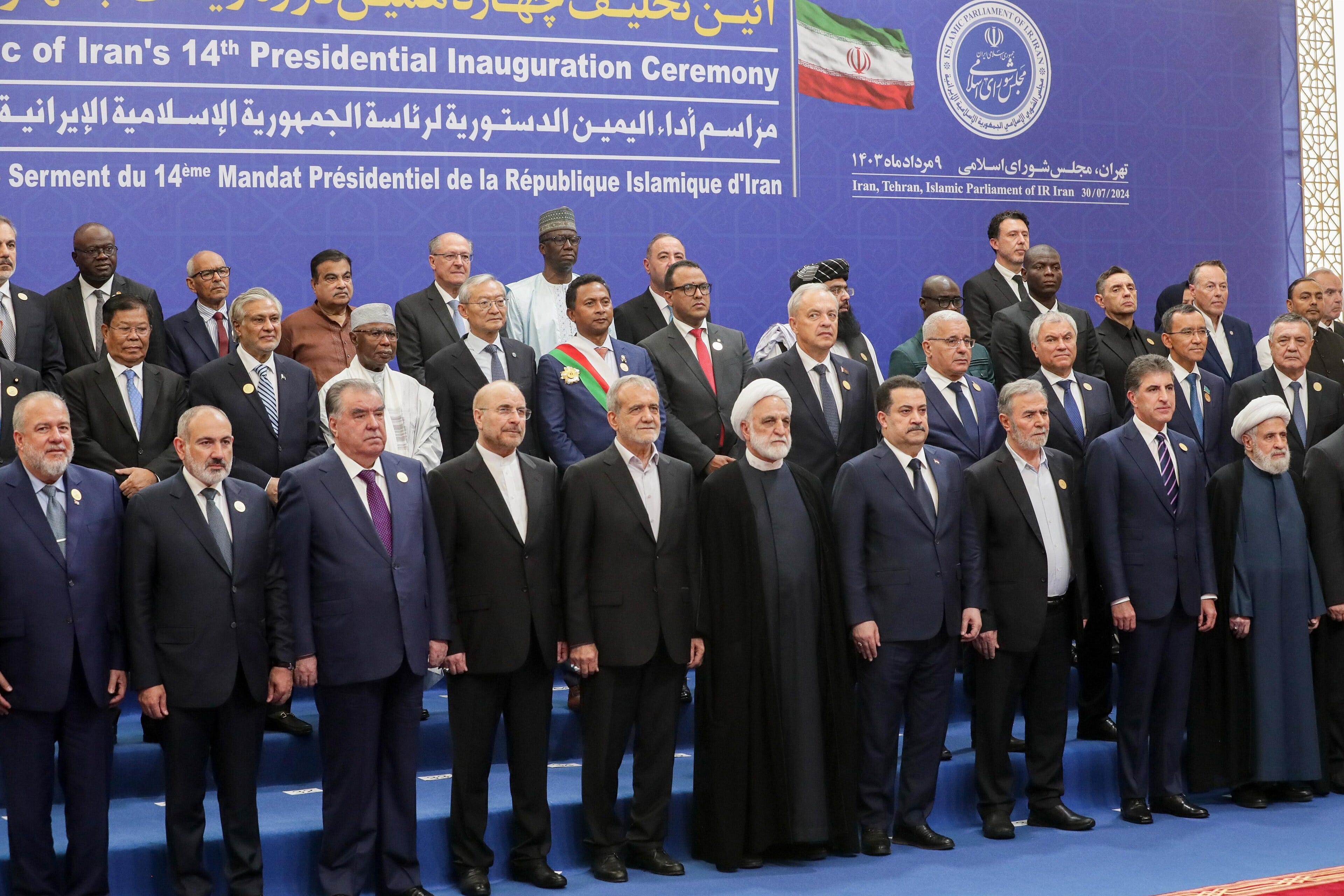
Iran got the same benefit of the doubt. In February 2023 Brazil let two Iranian warships, the Makran and the Dena, dock in Rio de Janeiro weeks after Washington had sanctioned them, over objections from the United States and Israel. In July 2024 Vice President Geraldo Alckmin represented Brazil at the inauguration of Iran's president, Masoud Pezeshkian, and was photographed in the same row as Hamas leader Ismail Haniyeh, Hezbollah's Naim Qassem, Islamic Jihad's Ziyad al-Nakhalah and a Houthi spokesman; Haniyeh was killed in Tehran hours later. The government said he attended as Brazil's official representative, and O Globo reported that he did not speak with Haniyeh. (Reuters; USNI News; Estadão; O Globo)
Operational Context
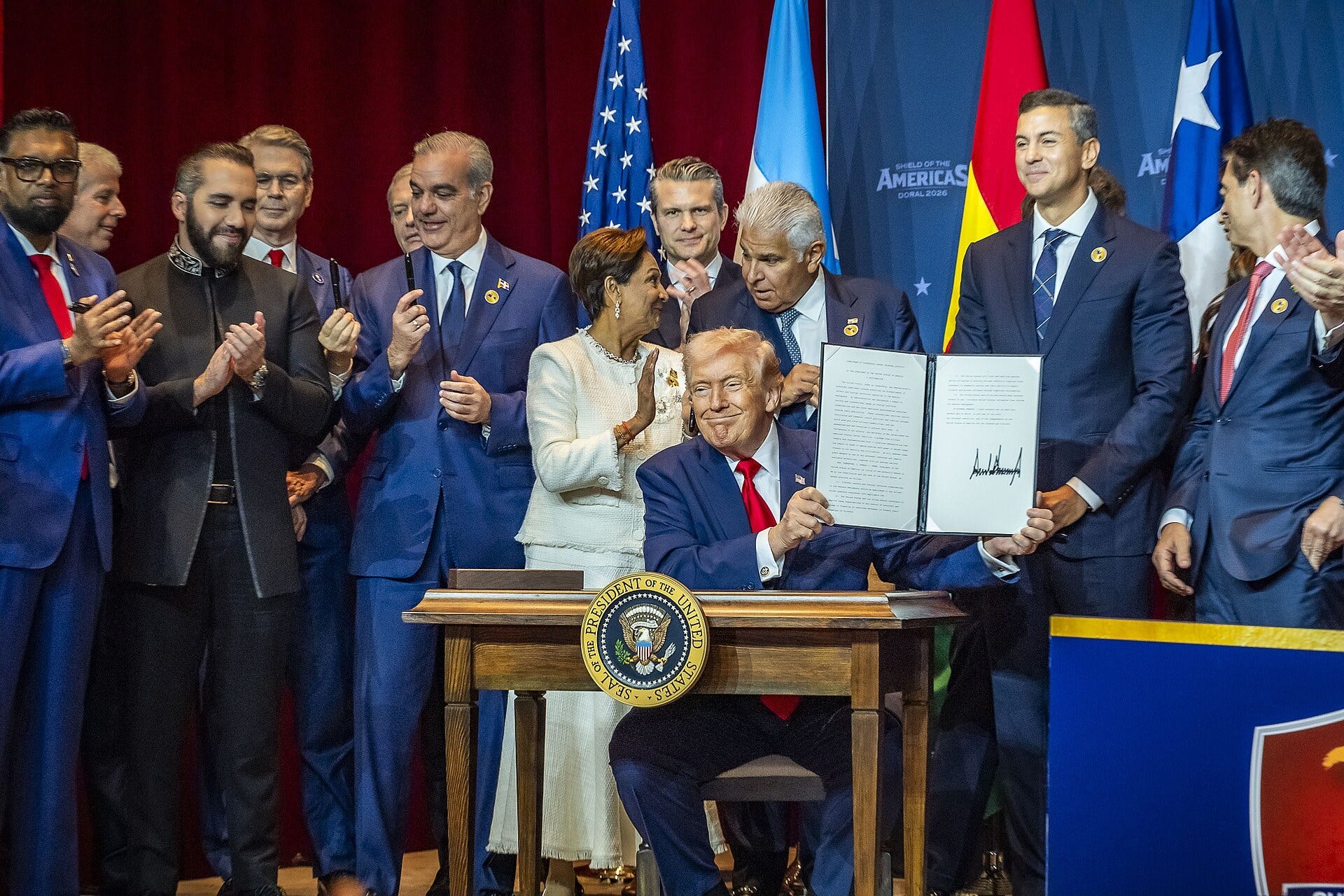
None of this happened without Washington. The December 2025 National Security Strategy commits the United States to "reassert and enforce the Monroe Doctrine" through what it calls a "Trump Corollary," and to deny rival powers the ability to own or control "strategically vital assets" in the hemisphere. The administration has applied that line with money, sanctions and force, and it has a club for its partners. In March Trump hosted twelve regional leaders at his Doral resort in Florida, among them Milei, Noboa, Paraguay's Santiago Peña, Bolivia's Paz and Kast, then still president-elect, to launch an Americas Counter-Cartel Coalition built on intelligence sharing and military cooperation. Brazil and Colombia were not there; their governments said they had not been invited, and Trump later said they had been. (White House; AP via SFGate; Foreign Policy)
In Argentina, Trump said in October 2025 that a $20 billion currency swap depended on Milei's party winning the midterms: "we're not going to waste our time" otherwise. It won; Argentina drew about $2.5 billion and repaid it by January. Panama announced its exit from the Belt and Road after a visit from Marco Rubio, though President José Raúl Mulino denied that Washington had ordered it. In Colombia, Washington declared that Bogotá had failed to meet its counternarcotics obligations, which cuts some U.S. aid, and in October 2025 sanctioned Petro, his wife, his son and his interior minister, accusing them of involvement in the drug trade, which they deny. (Reuters; Reuters; U.S. State Department)
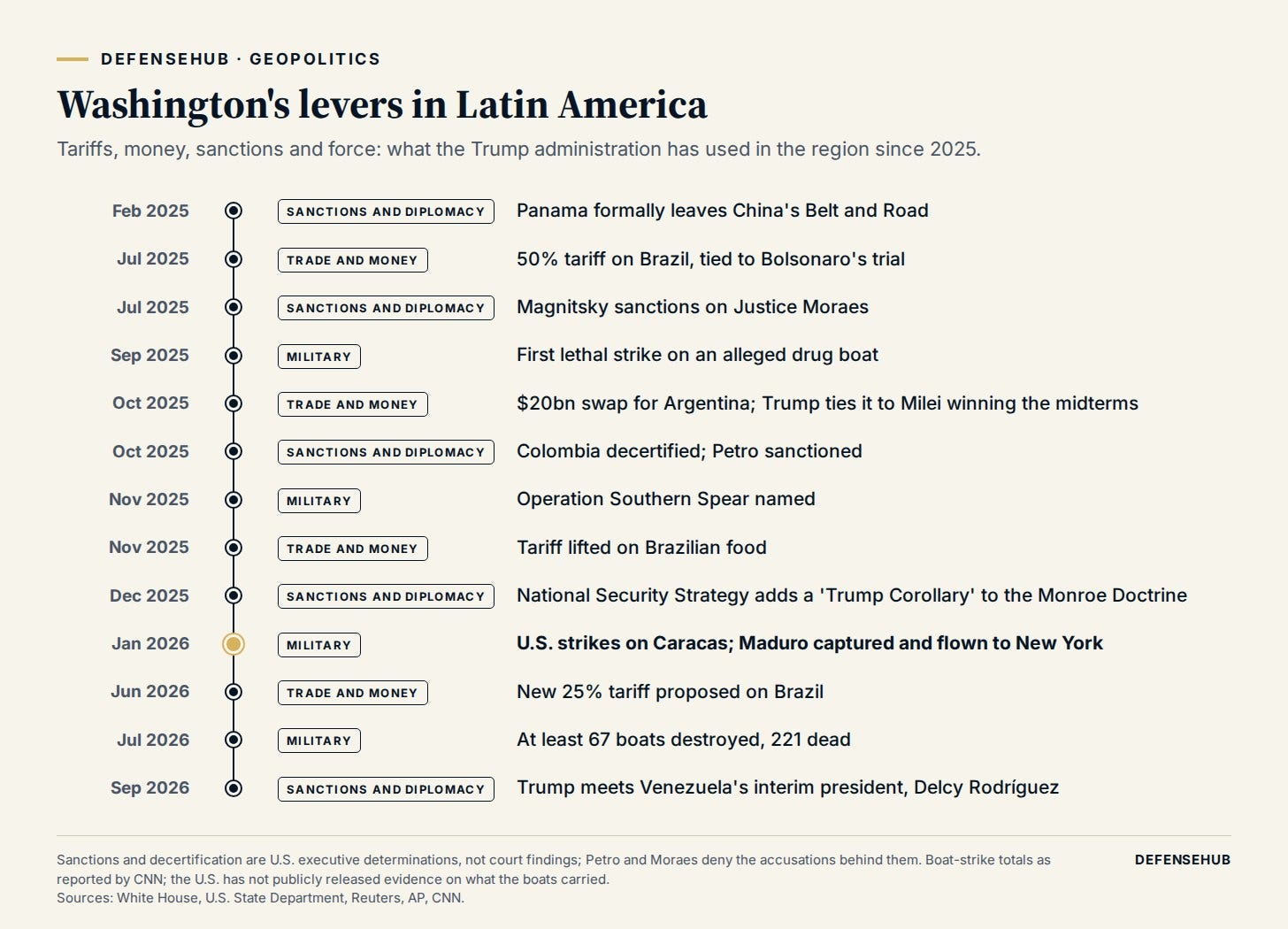
Brazil got the bluntest treatment. In July 2025 Trump imposed a 50% tariff and tied it explicitly to the prosecution of Jair Bolsonaro, which he called a "witch hunt," and Treasury sanctioned Supreme Court justice Alexandre de Moraes under the Magnitsky Act, a law built to freeze the assets of foreign officials accused of abuses. Food products were later exempted, and in June 2026 the trade representative proposed a new 25% tariff over digital trade and deforestation. In September 2025 a Supreme Court panel convicted Bolsonaro of plotting to overturn the 2022 election and sentenced him to 27 years and three months; he denies the charges, calls the case political persecution, and is serving the sentence under humanitarian house arrest granted on health grounds in March. In July his son Flávio, now the candidate, lobbied Washington to delay the new tariff until after the vote. (Reuters; Reuters; Reuters; Reuters; Reuters)
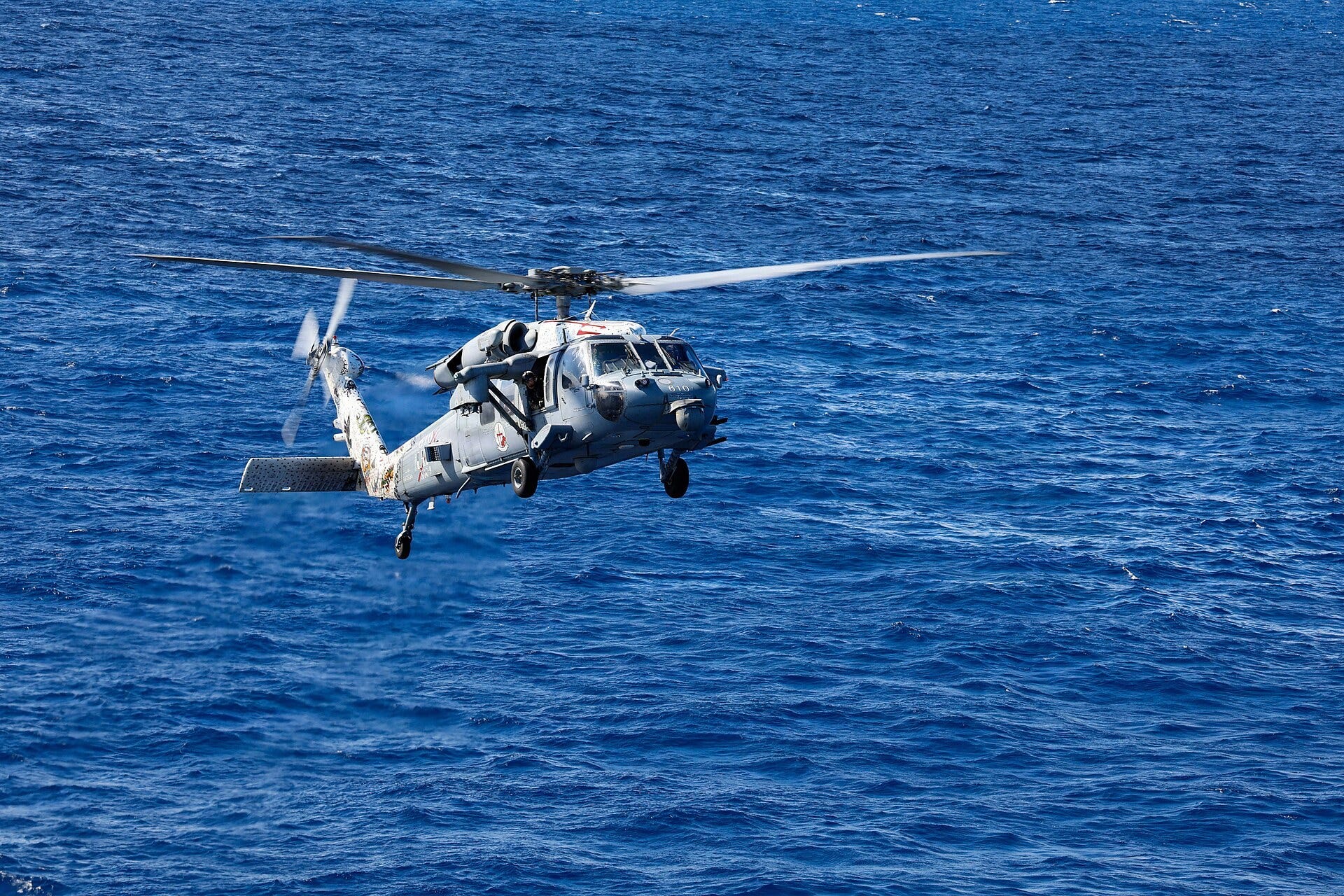
The military picture changed faster than the political one. From September 2025, under what became Operation Southern Spear, the United States destroyed boats it said were carrying drugs in the Caribbean and the eastern Pacific, at least 67 of them with at least 221 dead by July 2026, without publishing evidence about the cargo. About 12,000 troops on nearly a dozen ships were in the region when, on January 3, 2026, U.S. forces struck Caracas and captured Maduro and his wife, who now face narcoterrorism charges in New York. Lula said the operation "cross[ed] an unacceptable line." Delcy Rodríguez, Maduro's vice president, governs as interim president, signed oil deals with Chevron and others in September, met Trump at the United Nations, and has set no election date. María Corina Machado, who won the Nobel Peace Prize last year, remains outside the country. (CNN via KVIA; PBS; Reuters; Reuters)
Peru shows the alignment in procurement. Washington approved a possible $3.42 billion F-16 sale in September 2025, and Lima made a $462 million first payment in April. A separate $1.5 billion package covers work at the Callao naval base. The limits showed too: in November 2025 Ecuadorians rejected, by about two to one, Noboa's proposal to allow foreign military bases, even though Noboa is one of Washington's closest partners in the region. (DSCA; Reuters; Reuters)
My Read
The rightward turn is first of all a verdict, and voters delivered it at the ballot box. Governments that presided over shortages, rising crime and convictions of their own leaders lost to opponents who promised order. Foreign policy added to it. Leaders who called Venezuela's crisis a narrative and stood beside Putin in Moscow made it easy for opponents to argue that the left had chosen the wrong friends. When the sharpest public rebuke of Lula's "narrative" remark came from a left-wing Chilean president, the problem was not a right-wing invention.
But a verdict is not yet a program, and the new governments face two tests. The first is institutional. Bolsonaro's conviction divides the country, and his supporters see it as persecution; a right that wants to be trusted with power has to contest it in Brazil's courts, Congress and ballot boxes rather than ask Washington to punish the judges. The court has its own homework: until the Banco Master questions get answered, its verdicts will carry little weight with the voters who already distrust it, and that distrust is now one of the right's strongest arguments. The second is sovereignty. American pressure helped some of these winners, and the Monroe Doctrine framing is candid about what Washington wants: access, minerals, and no Chinese ports or Russian advisers. Those interests overlap with South America's in many places. They are not the same thing, and Venezuela shows it. Maduro is gone, which almost nobody in the region regrets, yet nine months later the opposition that won in 2024 is outside the room while oil contracts are signed inside it.
Brazil is where both tests meet. Every final poll had Lula ahead in the first round, and Flávio Bolsonaro finished first. Most of the candidates eliminated yesterday ran on the center-right, the pollsters who underestimated him once now have to explain why their runoff numbers deserve more trust, and a sitting president who finishes second in the first round starts the runoff on the back foot. On my reading, Flávio's chances of winning on October 25 are very high. Whether it holds up will depend on whether it looks like Brazil's own decision. A government in Brasília that is tough on corruption, skeptical of Beijing and Moscow and friendly to Washington would change the balance of the hemisphere. One that appears to have been installed by tariffs would hand its opponents the argument they need.
What to Watch
Where do the voters of Augusto Cury, Renan Santos, Ronaldo Caiado and Romeu Zema go on October 25, and can Lula recover from a first-round defeat that no final poll anticipated?
Does Washington say anything about the Brazilian vote before the runoff, and does the 25% tariff proposal move?
Does Delcy Rodríguez announce an election date, and is María Corina Machado allowed back into Venezuela?
Do Kast, Fujimori and de la Espriella cut back Chinese projects such as Chancay and Colombia's Belt and Road agreement, or keep the trade and drop the rhetoric?
Does the U.S. boat campaign resume at its 2025 pace, and does any South American government grant new basing access?
Recommended Sources
The White House's December 2025 National Security Strategy, Western Hemisphere section: the "Trump Corollary" in Washington's own words.
Reuters' Latin America election coverage: results, runoff margins and the polling that preceded them.
Agência Brasil and G1 on the INSS pension fraud: the investigation's numbers and the inquiry's outcome without campaign spin.
The Congressional Research Service and Defense Department reporting on Operation Southern Spear: the military campaign's scale and its legal questions.
Brazil's Superior Electoral Court results page tonight and on October 25: the only count that matters.