

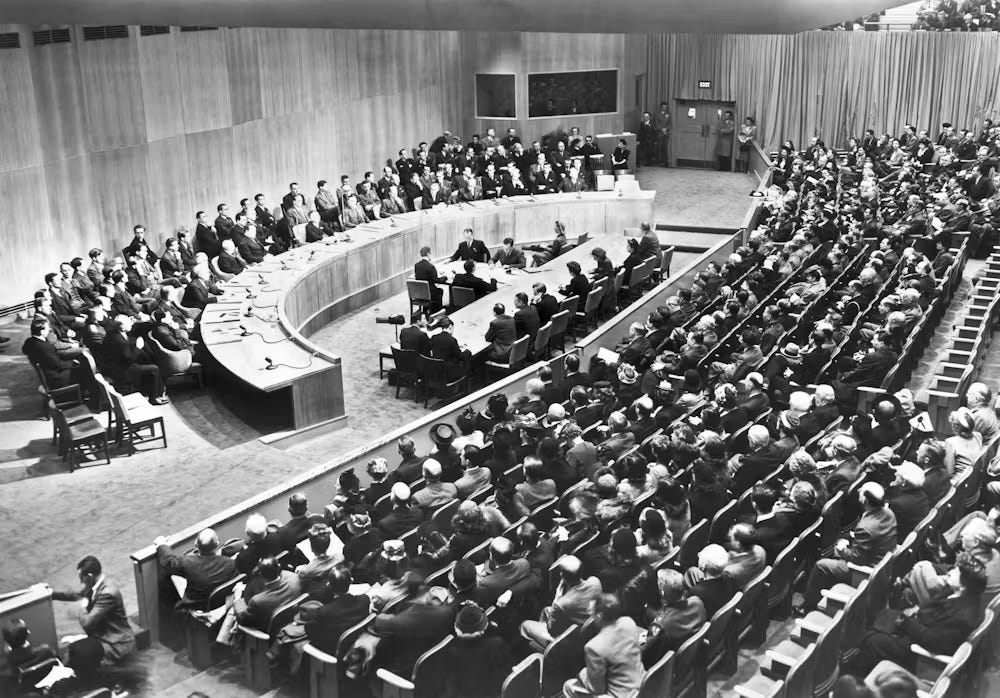
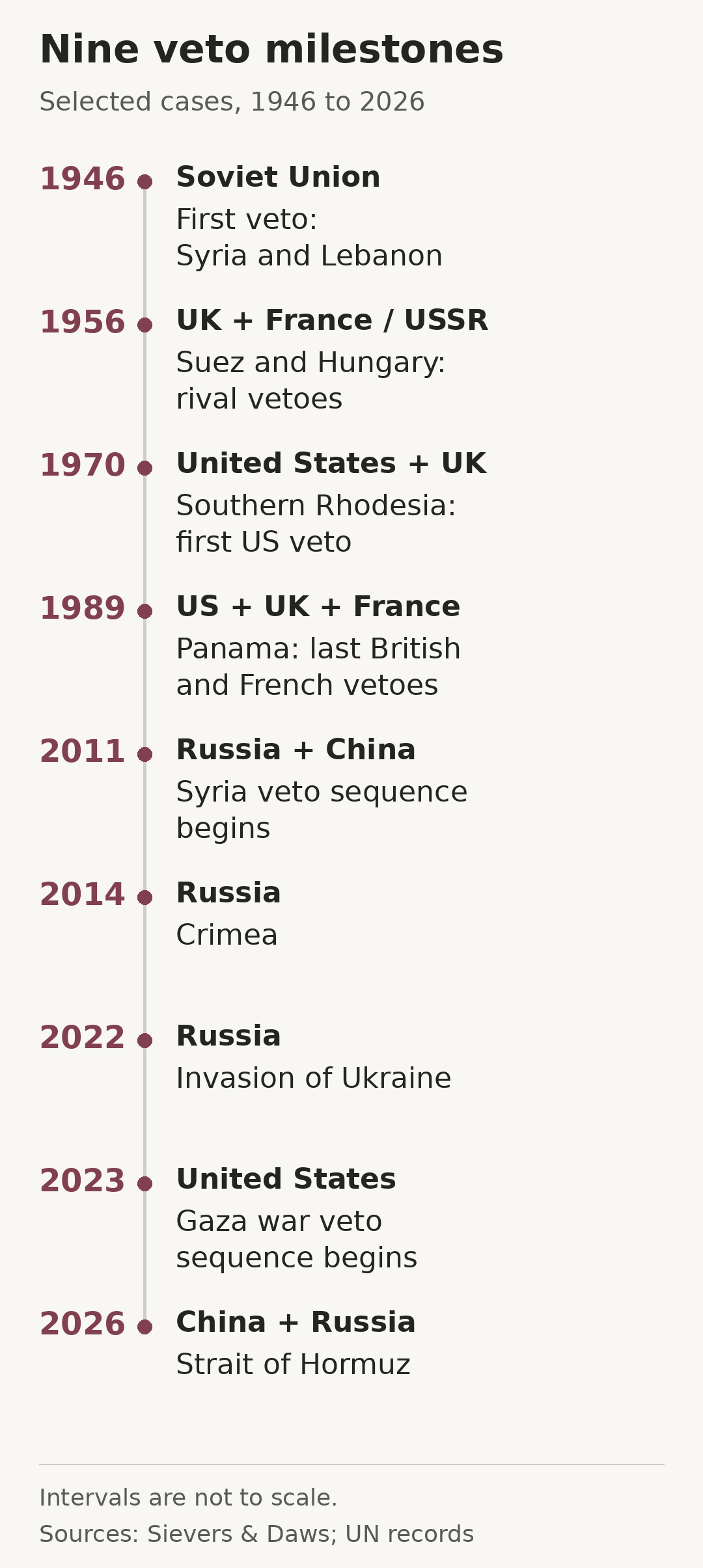
On February 16, 1946, less than a month after the Security Council first met, the Soviet Union blocked a proposal concerning the withdrawal of British and French troops from Syria and Lebanon. It was the first veto in United Nations history.
Eighty years later, the mechanism remains intact. By September 5, 2026, the five permanent members had cast 322 individual vetoes against 265 proposals. A joint veto counts once for each member casting it, even though only one proposal is blocked. The total also includes two private-meeting cases excluded from the national subtotals (Sievers & Daws, Table 4).
The national series, updated with the joint Chinese-Russian veto of April 7, 2026, puts Russia and the former Soviet Union at 156, followed by the United States at 94, the United Kingdom at 30, China at 22 and France at 18. These attributed totals sum to 320; the two private cases bring the overall count to 322 (Dag Hammarskjöld Library).
Why the Council Was Created
The United Nations emerged from World War II as an attempt to build a system capable of responding to threats to peace. The Charter, signed in San Francisco in June 1945, assigned the Security Council primary responsibility for international peace and security. Unlike the General Assembly, which generally makes recommendations, the Council can adopt binding decisions, impose sanctions and authorize the use of force. Its first session took place in London on January 17, 1946.
The original Council had 11 members: five permanent and six elected. The United States, the Soviet Union, the United Kingdom, China and France received permanent seats because of their place in the postwar balance of power. In political terms, they represented the principal victors of the war and the powers considered indispensable to any functioning system of collective security (Dag Hammarskjöld Library).
The arrangement preserved the permanent seats established in 1945. China’s seat belonged to the Republic of China until 1971, when it passed to the People’s Republic of China; the Russian Federation succeeded the Soviet Union. The Council expanded from 11 to 15 members in 1965, with ten nonpermanent seats elected for two-year terms and distributed by region. The five permanent seats remained unchanged.
How the Veto Works
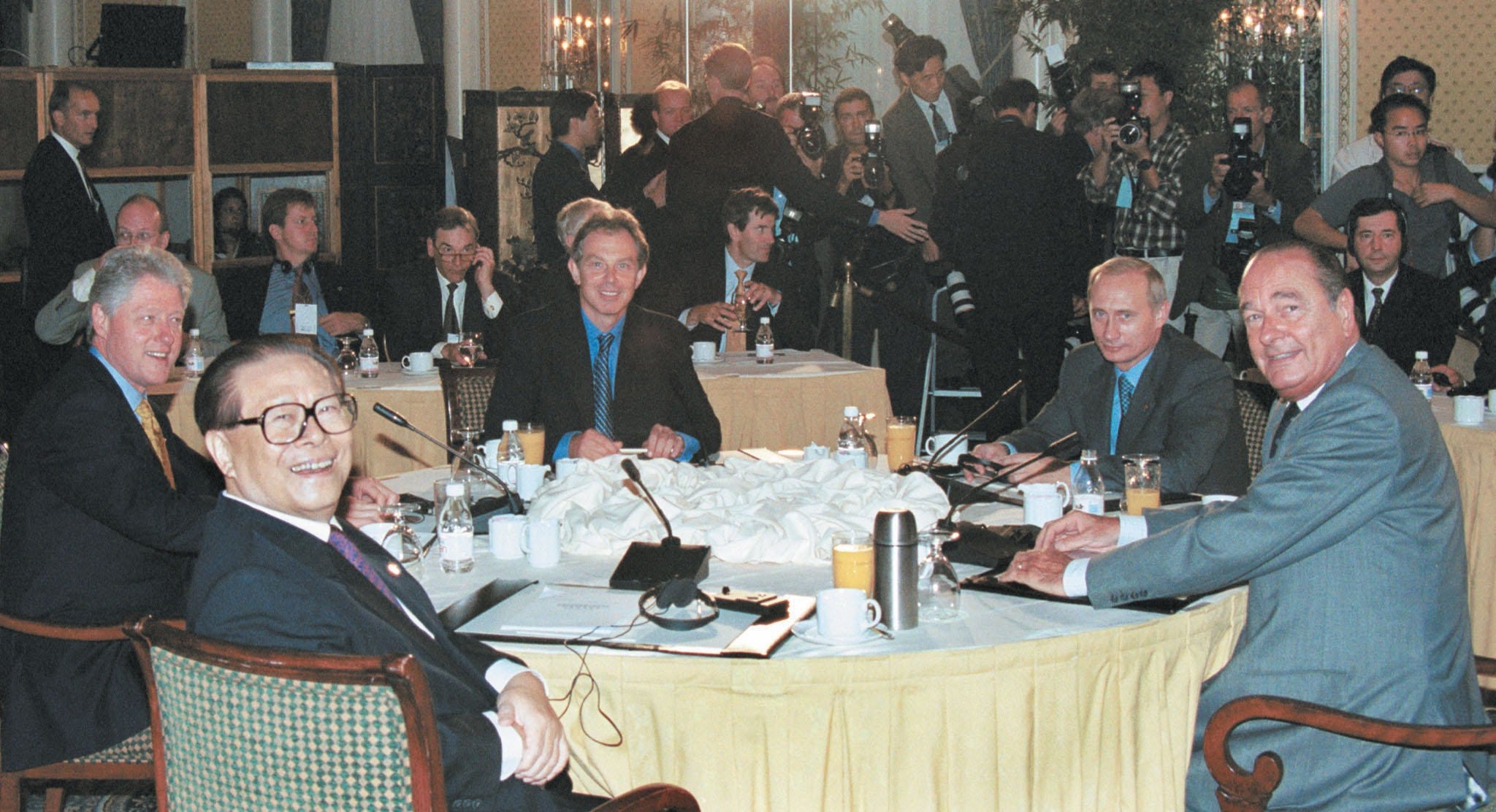
The word “veto” does not appear in the UN Charter. The power derives from Article 27: procedural decisions require nine affirmative votes, while substantive decisions require nine votes including the concurrence of the permanent members. In practice, a negative vote by any one of them defeats a substantive proposal. An abstention does not.
Article 27(3) also requires a party to a dispute to abstain in decisions under Chapter VI and Article 52(3). That obligation has a defined scope; it is not a general ban on voting in every case involving the member’s own interests (UN Charter).
The design grew out of the Yalta formula. The victorious powers would not have joined an organization able to act directly against their vital interests. The veto was the price of their participation.
That logic also makes reform difficult. Under Article 108, amendments require adoption by two thirds of General Assembly members and ratification by two thirds of UN members, including all five permanent members.
Veto Totals by Permanent Member
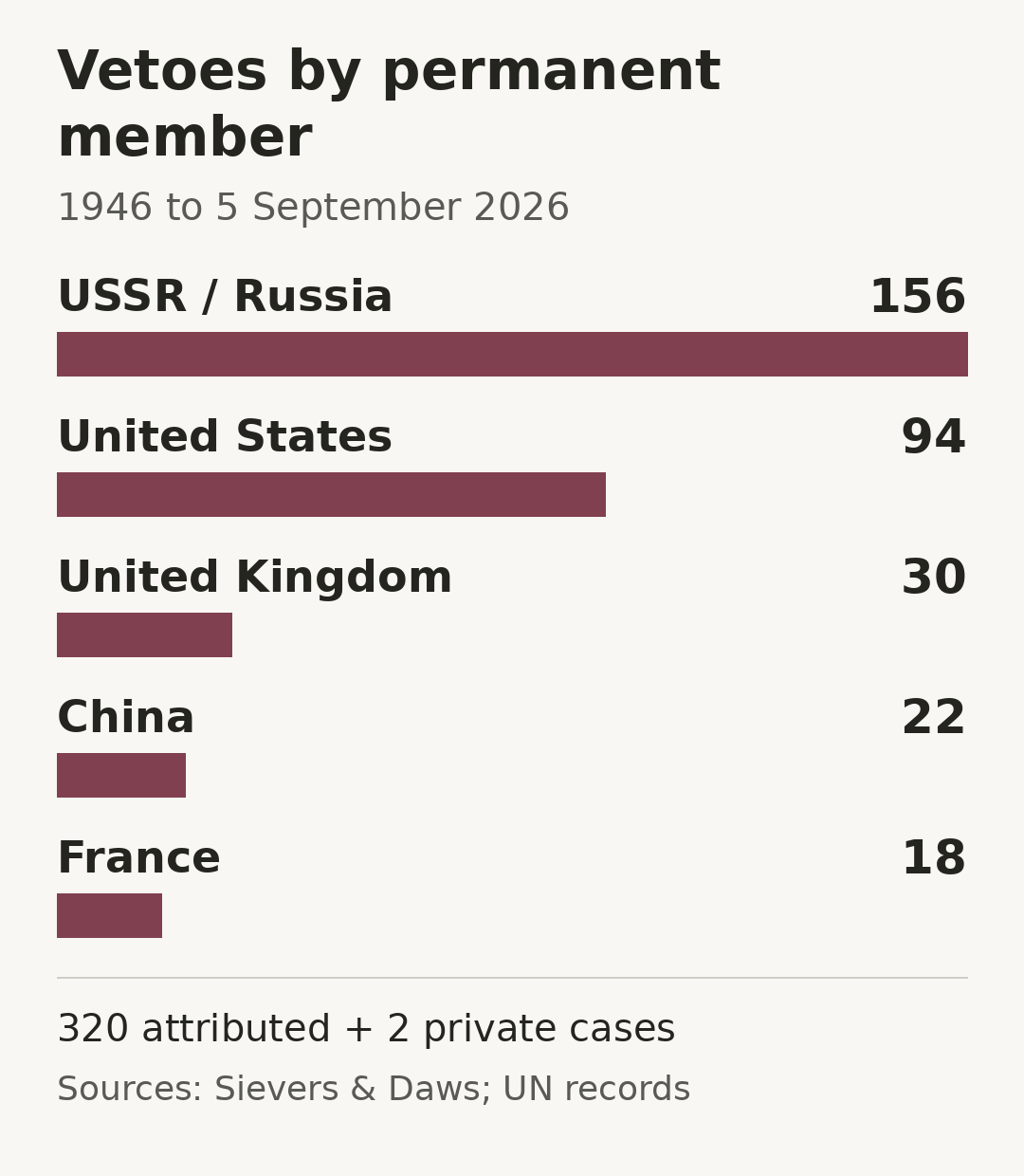
Methodology: The national totals use Sievers and Daws through September 18, 2025, updated with the April 7, 2026 vote. The series combines the Soviet Union and the Russian Federation. For China, it combines one veto cast by the Republic of China, which held the seat until 1971, with those cast by the People’s Republic of China.
The overall total also includes two proposals vetoed in private meetings on the selection of the secretary-general, in 1953 and 1996. Because the official communiqués did not identify the members that cast those vetoes, the two cases are not included in the national subtotals.
Soviet Union and Russia: From Gatekeeper to Strategic Shield
Of the 156 vetoes in the Soviet-Russian series, 114 were cast by the Soviet Union. Moscow initially used the veto to control the expansion of a UN it viewed as pro-Western. In December 1955, it blocked applications from countries including Italy, Japan and Spain before an agreement allowed 16 states to join. The veto also protected interventions and allies in Hungary, Afghanistan, the Congo and the India-Pakistan conflict (Sievers & Daws, Table 4).
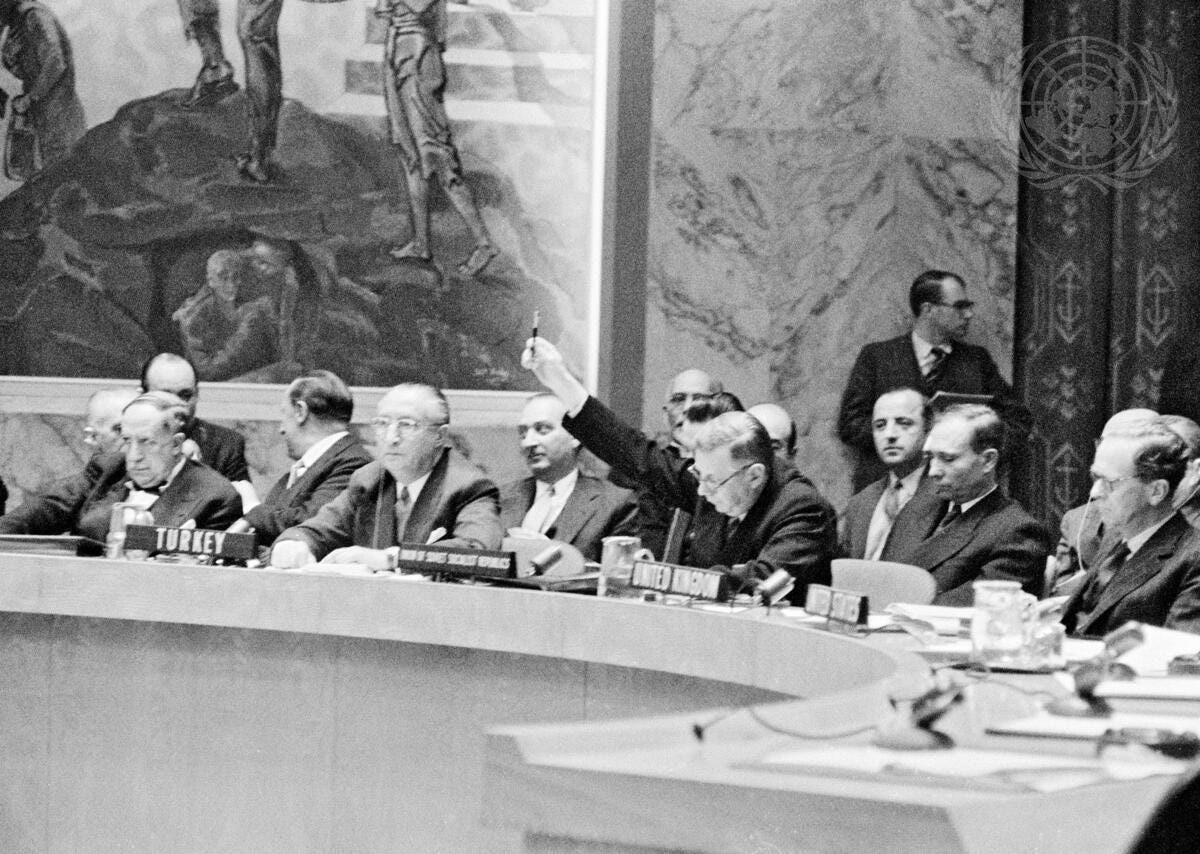
After vetoes became less frequent in the 1990s, Moscow’s use increased over Syria from 2011. Security Council Report records 18 draft resolutions blocked over Syria, all vetoed by Russia and ten jointly with China. The proposals covered sanctions, referral to the International Criminal Court and humanitarian mechanisms.
In Ukraine, the state accused of aggression prevented the Council from acting. Russia vetoed texts concerning Crimea, Malaysia Airlines Flight MH17, the full-scale invasion and attempted annexations. In February 2022, it vetoed a demand that it withdraw its forces, despite 11 votes in favor; three members abstained.
United States: Israel as a Red Line
Washington waited 24 years before using the veto. Its first came in 1970, alongside the United Kingdom, over Southern Rhodesia, after decolonization had already eroded the automatic majority the United States had once enjoyed.
In later decades, Washington protected allies and its own actions, blocking texts concerning Vietnam, Angola, Nicaragua, Libya and Panama. Together with London and Paris, it blocked ten draft resolutions on South Africa and Namibia between 1974 and 1981 (Security Council Report).
Israel and Palestine define the American pattern: 38 of the 94 US vetoes appear directly under agenda headings related to the question of Palestine, even before texts filed under broader Middle East or Lebanon headings are counted.
Between October 2023 and September 2025, Washington cast seven vetoes directly related to Gaza, including an amendment, and separately vetoed Palestine’s admission to the United Nations. At the Council’s 10,000th meeting, it cast the sole vote against a ceasefire supported by the other 14 members.
United Kingdom and France: The End of the Imperial Veto
London cast all 30 of its vetoes between 1956 and 1989; Paris cast its 18 between 1946 and 1989. Neither has used the veto since.
During the Suez Crisis in October 1956, the United Kingdom and France vetoed two draft resolutions intended to halt the operation against Egypt. The issue moved to the General Assembly, which created the first United Nations Emergency Force. In the same week, the Soviet Union used its veto to shield its intervention in Hungary. The contrast exposed a lasting rule: great powers condemn an adversary’s veto but defend the instrument when it protects their own interests (UN, “Uniting for Peace”).
The United Kingdom cast five lone vetoes on Rhodesia. During the Falklands War, it joined the United States in vetoing a ceasefire proposal on June 4, 1982. France defended overseas interests in Indonesia and the Comoros. Both countries ended their veto record in 1989, alongside the United States, over the invasion of Panama (Sievers & Daws, Table 4).
Paris and London later embraced voluntary restraint. Both endorsed the ACT Group’s Code of Conduct, while France and Mexico lead an initiative calling for the voluntary suspension of the veto in cases of mass atrocities, an initiative supported by 107 states (Security Council Report).
China: From Restraint to Alignment with Moscow
The Chinese count begins with the Republic of China, which vetoed Mongolia’s admission in 1955. After the People’s Republic of China took the seat in 1971, Beijing vetoed Bangladesh’s admission in August 1972. Two weeks later, alongside the Soviet Union, it vetoed an amendment to a draft resolution on the Middle East. Beijing then went nearly 25 years without using the veto again (UN Digital Library, S/PV.1662).
In the 1990s, the dispute over Taiwan reached the Council. China blocked a mission in Guatemala in 1997 and an operation in Macedonia in 1999, both countries that maintained relations with Taipei.
The shift came in 2007. Of the 20 vetoes cast by the People’s Republic through 2025, 15 came from that year onward, all alongside Russia, on issues including Syria, Venezuela, North Korea and Gaza (Security Council Report). In April 2026, the two countries vetoed a proposal concerning navigation through the Strait of Hormuz. Eleven members supported it and two abstained.
Beijing still uses the veto far less often than Moscow or Washington, having historically preferred to abstain. Its recent pattern, however, has turned the veto into an expression of Chinese-Russian convergence against sanctions, intervention and accountability mechanisms.
The Veto’s Invisible Power
The statistics record only texts put to a vote. They do not capture the “pocket veto”: proposals weakened, negotiations abandoned and crises kept off the Council floor because other countries anticipate opposition from a permanent member. Security Council Report identifies Rwanda, Kosovo, Sudan and Sri Lanka as cases shaped by such threats. In March 2003, the United States, the United Kingdom and Spain abandoned a vote on a second resolution concerning Iraq in the face of French opposition and insufficient support. The US- and UK-led invasion followed without new Council authorization.
Resolution 76/262, adopted in 2022, requires the president of the General Assembly to convene a debate within ten working days of a veto, unless the Assembly meets in an emergency special session on the same situation. The debate cannot reverse the veto. The resolution gives the vetoing member priority to speak, but does not require it to present a defense.
Representatives told the Assembly in November 2025 that 17 vetoes had triggered 17 such meetings. The mechanism exposes the decisions to wider political scrutiny; it does not give the Assembly the Council’s enforcement powers.
Why Reform Has Stalled
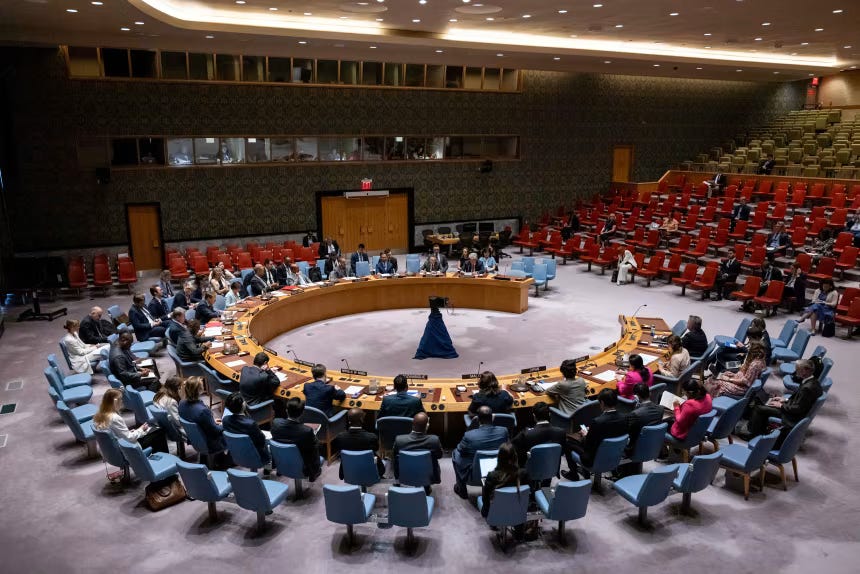
The Council’s permanent membership still reflects the settlement of 1945, even though the United Nations has grown from 51 founding members to 193. The absence of permanent African or Latin American seats, and the presence of only one Asian permanent member, contribute to a crisis of legitimacy. In May 2026, Secretary-General António Guterres called again for expansion in both membership categories.
The General Assembly’s convergence document sets out competing proposals:
The G4 (Brazil, Germany, India and Japan) advocates six new permanent seats: two for Africa, two for Asia-Pacific, one for Latin America and the Caribbean, and one for Western Europe and other states.
The African common position demands at least two permanent seats chosen by the continent and, for as long as the veto exists, the same rights as the current P5.
Uniting for Consensus, which includes Italy and Pakistan, opposes new permanent members and favors more elected seats or longer, renewable terms.
The veto is another dividing line. Options range from abolition or restriction to Chapter VII cases to a requirement that two permanent members vote against a decision before it can be blocked. Support has grown for voluntary abstention in cases of genocide, crimes against humanity and war crimes. Launched in 2009 under a 2008 General Assembly decision, the intergovernmental negotiations have yet to produce an agreed reform package.
I see little prospect of abolishing the veto while all five permanent members must ratify that change. Voluntary restraint and Assembly scrutiny leave the power intact; their value depends on whether they change a member’s decision to use it. I would judge those efforts by whether permanent members withhold a veto during a crisis.
See also


Recommended Sources
Sievers & Daws, Table 4: vetoed proposals and national totals
2025 document on convergence and divergence in Council reform
Sources & Methodology
This article draws on UN voting records, Charter provisions and institutional histories. Counts follow the Sievers and Daws series, updated with the April 7, 2026 vote and checked against the UN veto list. The series includes draft resolutions and amendments. Its treatment of two private-meeting cases is explained beside the totals. The closing assessment is the author’s interpretation.
Corrections or source clarifications can be sent through the DefenseHub contact page.
R. Planche · DefenseHub